

Table of Contents
- Why Sustainable Leather Matters Now
- Bio-Fabricated Leather: Lab-Grown Options Explained
- Mycelium and Plant-Based Leather Alternatives
- Vegetable-Tanned Leather Benefits vs. Chrome Tanning
- How to Care for Leather Handbags and Extend Their Life
- Slow Fashion Leather Accessories: Artisan Pieces That Last
- How to Spot Greenwashing and Verify Ethical Sourcing
- The Bottom Line: Building a Sustainable Leather Wardrobe
- Frequently Asked Questions
Last Updated: September 4, 2026
Sustainable leather has become the defining question in fashion. As shoppers demand eco-friendly alternatives, the market offers everything from lab-grown mycelium to vegetable-tanned hides, making it hard to separate genuine progress from clever marketing. This guide shows which materials, tanning methods, and buying strategies actually reduce environmental impact without sacrificing quality.
The term sustainable leather covers wildly different materials with very different footprints, from lab-grown options to plant-based synthetics that rely on plastic binders. Below, we break down the material science, explain what to look for in tanning, and give you a framework for verifying claims before you buy.
Why Sustainable Leather Matters Now
Fashion accounts for a substantial share of global textile waste, and the leather industry faces scrutiny over chemical use in tanning and cattle farming's carbon footprint. The shift toward sustainable leather responds to consumers demanding supply chain transparency and a growing regulatory focus on environmental claims in the United States.
The stakes go beyond ethics. A poorly made "vegan leather" bag that peels within months creates more waste than a well-crafted leather piece that lasts a decade. This is the core tension of the sustainable fashion movement: durability itself is a sustainability feature. The United States Environmental Protection Agency's guide on sustainable materials management emphasizes that extending product lifespan is one of the most effective ways to reduce waste.

No material is perfect. Every option involves trade-offs between land use, chemical inputs, durability, and end-of-life disposal. A truly sustainable choice weighs all these factors rather than latching onto a single buzzword.
Bio-Fabricated Leather: Lab-Grown Options Explained
Bio-fabricated leather grows leather-like material from living cells in controlled laboratory conditions, eliminating animal agriculture while producing a material chemically similar to traditional hide.
The most established options use mycelium, the root structure of mushrooms, grown into dense, flexible sheets that mimic animal skin. Companies like Bolt Threads and MycoWorks have pioneered this space. These materials are biodegradable, cruelty-free, and require significantly less water and land than cattle farming.
However, the technology remains young: production capacity is limited, costs run higher, and long-term durability data is still emerging. If you're an early adopter, verify the product uses no synthetic binders that would compromise its biodegradable claims.
Mycelium and Plant-Based Leather Alternatives
Plant-based leather alternatives have exploded in popularity, but they demand careful scrutiny. The term covers everything from piñatex made from pineapple leaf fibers to apple peel, cactus, and mushroom-derived mycelium.
:::
Piñatex uses pineapple leaf fibers, a byproduct of existing agriculture, making it genuinely circular, though it requires a protective coating. Cactus leather is harvested from mature nopal pads, requiring minimal water and regenerating quickly. Apple leather upcycles apple peels from juice production.
The critical question for any plant-based option is its exact composition. A material that is 60% plant fiber and 40% polyurethane is not meaningfully more sustainable than a synthetic leather.
Vegetable-Tanned Leather Benefits vs. Chrome Tanning
Traditional leather can be sustainable when processed correctly. Vegetable tanning uses tannins from tree bark and plant matter, refined over centuries, while chrome tanning uses chromium salts for a faster, cheaper process.
Vegetable tanning uses renewable plant materials, produces biodegradable waste, and creates leather that develops a patina over decades. Chrome tanning, which handles roughly 80% of global production, is faster and softer, but raises concerns about chromium waste in waterways and occupational exposure.
For the conscious consumer, vegetable-tanned leather offers the clearest path to sustainability within the traditional category. It aligns with slow fashion principles because it is designed to last and age gracefully. The trade-off is cost: vegetable tanning takes longer and costs more.
How to Care for Leather Handbags and Extend Their Life
Learning how to care for leather handbags properly is the single most impactful sustainability practice you can adopt. A bag that lasts 15 years instead of 3 reduces its per-year environmental footprint by roughly 80%. The deeper question is repairability, the metric that separates an investment piece from a disposable one.
The Repairability Test: What to Check Before You Buy
Before you commit to a bag, ask the maker or retailer these four questions. Their answers tell you more about the bag's true lifespan than any marketing claim:
- Can the stitching be re-done? Look for bags where the seams are accessible and not glued under a lining. A bag with visible, reinforced stitching can be re-sewn by a cobbler for $20-$50. A bag where the lining is fused to the outer layer often cannot be repaired at all.
- Is the hardware replaceable? Zippers, buckles, and clasps wear out faster than leather. Brands that sell replacement hardware or use standard sizes (like YKK zippers) make repairs far easier. Custom, proprietary hardware can turn a $10 zipper failure into a $150 repair bill or a total loss.
- Does the brand offer a repair service? If a brand won't stand behind its work, that's a red flag about durability.
- What is the material's tear strength? Vegetable-tanned leather and high-quality mycelium leathers have documented tear strength data. A material that tears easily is not repairable in any practical sense.
The 5-Step Care Protocol That Actually Extends Lifespan
Most guides stop at 'condition regularly.' Here's the protocol that leather conservators and artisan workshops recommend:
- Condition every 3-4 months, but only with the right product. For vegetable-tanned leather, use a conditioner with beeswax or lanolin. For mycelium or plant-based leathers, check the manufacturer's recommendation, many require silicone-free conditioners that won't break down the plant fibers. Over-conditioning (more than every 2-3 months) clogs pores and attracts dust, accelerating deterioration.
- Protect from moisture with a spray matched to the material. A water-repellent spray designed for suede will damage smooth leather, and a spray with fluorocarbons can harm bio-based materials. Look for sprays labeled 'safe for vegan leather' or 'plant-based leather compatible.'
- Store in a dust bag with acid-free tissue paper. Acidic tissue paper can cause discoloration over years. Use unbranded, unprinted tissue to avoid ink transfer.
- Rotate your bags to prevent stress fractures. Constant use of one bag puts repetitive stress on the same strap attachment points. Rotating between two or three bags can double the lifespan of each.
- Clean gently with a dry microfiber cloth after each use. For stains, use a damp cloth with a drop of mild soap, never soak the material. For mycelium leather, avoid water entirely; use a dry brush instead.
The Longevity Metric: Cost Per Wear, Recalculated
The standard cost-per-wear formula divides the purchase price by the number of wears. A more honest calculation includes repair costs over the bag's life:
Cost per wear = (Purchase price + Total repair costs) ÷ Total wears
A $300 vegetable-tanned bag worn 200 times per year for 10 years, with one $50 repair, costs $0.18 per wear. A $100 synthetic vegan leather bag worn 100 times per year for 2 years, with no repair possible, costs $0.50 per wear. The 'cheaper' bag is nearly 3x more expensive per wear, and it ends up in a landfill.
When Repair Isn't Possible: Responsible Disposal
Even with perfect care, every bag eventually reaches end of life. Before you toss it, check whether the material can be recycled or composted:
- Vegetable-tanned leather can be composted in industrial facilities, but it takes years to break down. Some municipalities accept it in green waste programs, check your local rules.
- Mycelium leather without synthetic binders is compostable in home compost systems within 12-24 weeks, according to material producers. Look for certification like 'OK Compost HOME' or 'TÜV Austria.'
- Plant-based leathers with PU/PVC backings are NOT compostable and should go to textile recycling, not the compost bin.
The Artisan Advantage: Built to Be Repaired
Hand-tooled bags from artisan workshops in León, Guanajuato, are constructed with techniques that assume future repair. The tooling is embossed into the leather surface, not printed on a coating, so it won't peel or flake. Stitching uses waxed thread that can be removed and replaced. This is the opposite of fast-fashion vegan leather, where the 'leather' is a thin polyurethane coating over a fabric base, once that coating cracks, the bag is garbage.
When you buy a piece designed for repairability, you're buying a system of maintenance that keeps it out of the landfill for decades.
Slow Fashion Leather Accessories: Artisan Pieces That Last
Slow fashion leather accessories are investment pieces designed for years of use, typically handcrafted by skilled artisans using traditional techniques. The movement prioritizes quality over quantity, ethical production over speed, and timeless design over seasonal novelty.
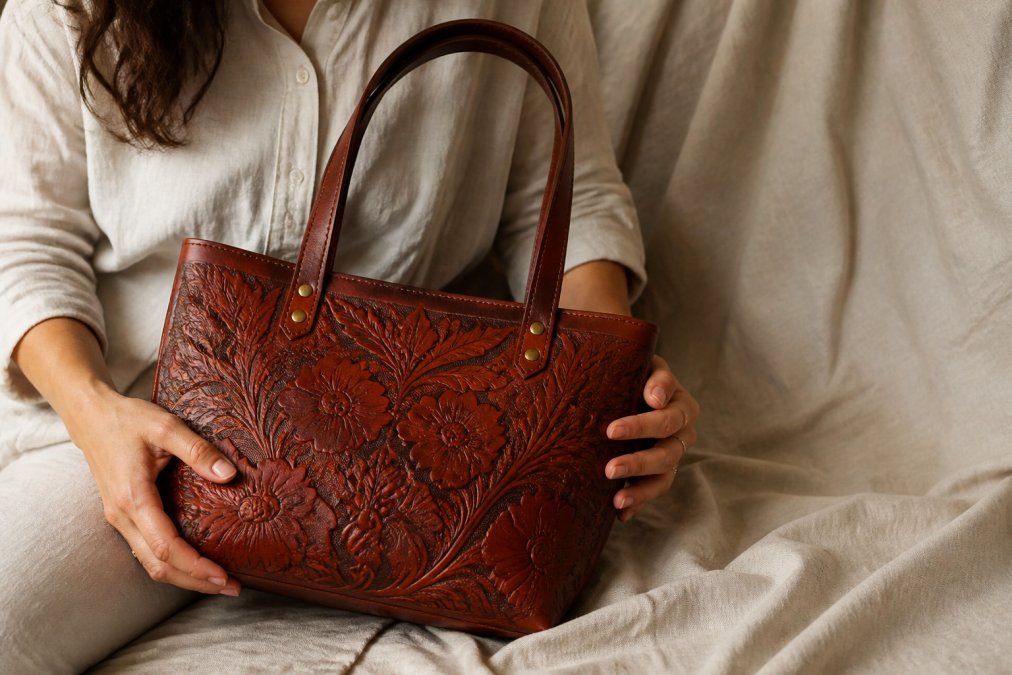
When you buy artisan-made leather goods, you're investing in the materials, the reduced carbon footprint of hand production versus factory manufacturing, and the preservation of craft skills that mass production threatens. Pieces from Lunas Artisanal Shop, handcrafted by Mexican artisans in León, Guanajuato, exemplify this approach.
The cost-per-wear calculation is the most honest way to evaluate any fashion purchase. A $40 bag that lasts two years costs roughly the same per wear as a $200 bag that lasts a decade, but the latter creates a fraction of the waste.
How to Spot Greenwashing and Verify Ethical Sourcing
Greenwashing, the practice of making misleading environmental claims, is rampant in fashion. The term 'vegan leather' frequently appears on products that are essentially plastic. But the deepest problem in 2026 isn't the obvious plastic-based 'vegan leather', it's the chemical toxicity hidden inside 'plant-based' and 'bio-based' materials that most guides never mention.
The Chemical Toxicity Gap: What 'Plant-Based' Really Means
Many 'plant-based' leathers are 40-60% polyurethane (PU) or PVC by weight. The plant fibers are the visible hero ingredient, but the material's structure comes from synthetic binders and coatings that make it flexible, water-resistant, and durable, and also non-biodegradable and potentially toxic.
When you see a product labeled 'plant-based leather,' ask for the full material safety data sheet (MSDS) or the chemical disclosure document. Legitimate manufacturers will provide this. If a brand can't or won't, that's a red flag.
The PFAS Problem in Leather Alternatives
Per- and polyfluoroalkyl substances (PFAS) are a class of 'forever chemicals' used in many water-repellent coatings on both traditional and alternative leathers. The Environmental Protection Agency's PFAS information identifies these chemicals as persistent in the environment and linked to health risks. In 2026, several states including California and Maine have enacted restrictions on PFAS in textiles, but enforcement varies.
Before buying any leather product, traditional or alternative, ask:
- Does this product contain PFAS? If the answer is 'we don't know,' treat it as a yes.
- Is the water-repellent coating fluorinated? Fluorinated coatings are the most common PFAS source.
- Does the brand test for PFAS? Brands that genuinely care will have third-party test results.
The Binder Breakdown: PU vs. PVC vs. Plant-Based Polymers
Not all synthetic binders are equal:
- PVC (polyvinyl chloride) is the worst option. It requires plasticizers (often phthalates) that are linked to endocrine disruption, and it releases toxic dioxins during production and incineration. Avoid any 'vegan leather' that doesn't explicitly state 'PVC-free.'
- PU (polyurethane) is better than PVC but still petroleum-based. Some PUs are now made with bio-based content (up to 30-40%), but the rest is still fossil-fuel derived. PU can also shed microplastics as it degrades.
- Plant-based polymers like polylactic acid (PLA) or polyhydroxyalkanoates (PHA) are emerging as alternatives, but they are not yet widely used in leather alternatives. When they are, they offer genuine biodegradability, but only if the entire material, including any coating, is also bio-based.
The Verification Framework: What to Ask and What to Look For
To verify claims and avoid greenwashing, demand specific documentation:
- What is the exact percentage of plant material by weight? A product that is 60% plant fiber and 40% PU is not meaningfully more sustainable than a synthetic leather. Look for products that disclose the full breakdown, 90%+ plant content is a meaningful claim.
- Is the tanning process disclosed with a standard? 'Chrome-free' and 'vegetable-tanned' are meaningful claims. 'Eco-tanned' without specifics is marketing language. Look for certification from Leather Working Group for traditional leather, which audits tanneries for environmental compliance.
- Does the brand name its suppliers? Genuine supply chain transparency means naming the tannery, the material supplier, and the workshop. If a brand says 'we source from Italy' without naming the tannery, that's not transparency.
- What is the end-of-life pathway? Can the material biodegrade in home compost, industrial compost, or neither? If the answer is 'neither,' the product is not circular.
- Is there third-party chemical testing? Look for OEKO-TEX Standard 100 certification, which tests for harmful substances, or bluesign certification for textile production. These are independent verifications, not self-reported claims.
The FTC Green Guides: Your Legal Backstop
The Federal Trade Commission's Green Guides provide clear guidance on what constitutes legitimate environmental marketing claims in the United States. Key provisions include:
- Unqualified 'eco-friendly' claims are deceptive unless the product has a specific, demonstrated environmental benefit.
- 'Recyclable' claims require that recycling facilities exist for the product in the area where it's sold.
- 'Biodegradable' claims require that the product will fully decompose within a reasonably short time in a real-world disposal environment, not just in a lab.
In 2026, the FTC has signaled increased enforcement of these guides in fashion. If a brand makes a claim that seems too good to be true, you can file a complaint with the FTC.
The Artisan Verification Standard
For handcrafted pieces from workshops in León, Guanajuato, verification often happens through direct relationship. Artisan cooperatives can show you the exact material rolls, the tanning certificates, and the workshop conditions. When you buy from a workshop that names its tanner and shows its material invoices, you're relying on a craftsman's reputation, not a marketing department.
The Bottom Line: Building a Sustainable Leather Wardrobe
Building a sustainable leather wardrobe in 2026 requires shifting from impulse buying to intentional curation. Start with a clear assessment of what you need, then invest in fewer, higher-quality pieces that will serve you for years.
The United Nations Environment Programme's fashion industry analysis highlights that extending the life of clothing by just nine months can reduce carbon, waste, and water footprints by around 20-30%. This principle applies directly to leather goods, making durability and repairability the most important sustainability metrics you can evaluate.
| Material | Key Advantage | Watch Out For | Best For |
|---|---|---|---|
| Vegetable-tanned leather | Biodegradable, ages beautifully | Higher cost, longer break-in | Investment bags, belts |
| Mycelium leather | Lab-grown, cruelty-free | Limited availability, new tech | Early adopters |
| Piñatex | Upcycled agricultural waste | Needs protective coating | Lightweight accessories |
| Synthetic vegan leather | Affordable, animal-free | Often plastic-based, short lifespan | Budget-conscious buyers |
| Artisan vegetable-tanned | Supports craftspeople, durable | Premium price point | Heirloom pieces |
When you're ready to invest, look for pieces that combine verified materials with genuine artisan craftsmanship. The hand-tooled vegan leather totes and hand-painted bags from Lunas Artisanal Shop offer a transparent middle path, crafted by Mexican artisans using materials you can verify. Each piece carries the cultural heritage of León, Guanajuato, while meeting modern standards for ethical production.

For most women, the right approach is a mix: one or two investment pieces in vegetable-tanned leather for daily use, plus plant-based options for trend-driven styles you'll rotate seasonally. This balanced strategy respects both your budget and the planet.
Building a truly sustainable leather wardrobe means overcoming the temptation to buy cheap, trendy items that end up in landfills within a season. The challenge is verifying materials, understanding tanning processes, and committing to proper care. Lunas Artisanal Shop makes this easier with handcrafted vegan leather bags and genuine leather accessories that combine cultural artistry with durable construction, each piece backed by transparent sourcing from Mexican artisan communities. Explore the collection and shop your story today.
Frequently Asked Questions
Is genuine leather considered sustainable in 2026?
Genuine leather's sustainability depends on the tanning process and sourcing. Conventionally chrome-tanned leather has a heavy environmental impact, while vegetable-tanned leather from farms practicing regenerative agriculture is a more responsible choice. The most sustainable option is one you keep for decades. Before buying, ask about the tannery's certifications, water use, and supply chain transparency. A well-made vegetable-tanned piece that lasts 20 years beats a cheaper alternative replaced every few seasons.
What is the difference between vegetable-tanned and chrome-tanned leather?
Vegetable tanning uses natural tannins from tree bark and plant matter, a process that takes weeks and produces leather that develops a rich patina over time. Chrome tanning uses chromium salts and takes about a day, yielding softer, cheaper leather. Vegetable-tanned leather benefits include biodegradability and lower toxicity at end-of-life. Chrome-tanned leather is harder to dispose of safely. For a sustainable purchase, prioritize vegetable-tanned goods, which also tend to last longer and age more beautifully.
How can you identify high-quality, ethically sourced leather goods?
Check the edge paint, stitching, and backing. High-quality leather has clean, sealed edges and tight, even stitching. Ask sellers directly about their supply chain. Responsible brands share where materials come from and how artisans are compensated. Look for terms like 'vegetable-tanned' or 'chrome-free' rather than vague claims like 'eco-friendly.' If a price seems too low for handcrafted work, question how the maker was paid. Real artisan craftsmanship has a cost that supports the community behind it.
What are the best practices for maintaining leather accessories to ensure longevity?
Store handbags in a dust bag away from direct sunlight and heat to prevent fading. Condition vegetable-tanned leather every 3 to 6 months with a natural balm to keep it supple. Clean spills immediately with a dry cloth. Avoid overstuffing bags, which disturbs their shape. Rotate your bags so none gets daily wear. When a strap or stitch breaks, find a cobbler who can repair it. Repairability is a core part of sustainable leather fashion.
How does artisan-crafted leather compare to mass-produced alternatives?
Artisan-crafted leather offers durability and repairability that mass-produced pieces rarely match. Machine-made bags from fast-fashion brands often use bonded leather or thin splits that peel within months. Artisan work from leather regions like León, Guanajuato, uses full-grain or top-grain hides cut to last. Each hand-tooled piece carries slight variations that prove its origin. While the upfront cost is higher, the cost-per-wear over a decade of use makes artisan leather the more economical, sustainable investment.
This article was written using GrandRanker