

Table of Contents
- Handmade vs Mass-Produced Leather Bags: The Core Differences
- Material Quality: Full-Grain Leather vs Corrected and Split Leather
- How to Identify High-Quality Leather Bags
- Durability and Long-Term Investment Value
- Benefits of Handcrafted Leather Purses
- Cost Analysis: Upfront Price vs Cost-Per-Wear
- Environmental Impact and Ethical Sourcing
- Repairability and Maintenance
Last Updated: August 17, 2026
Handmade vs Mass-Produced Leather Bags: The Core Differences
The difference between handmade and mass-produced leather bags goes far deeper than price. A handmade leather bag is created by skilled artisans who control every step, from selecting hides to finishing edges. A mass-produced leather bag rolls off factory assembly lines where efficiency and cost minimization drive every decision. These are fundamentally different approaches to leather goods.

What Defines Handmade Leather Goods
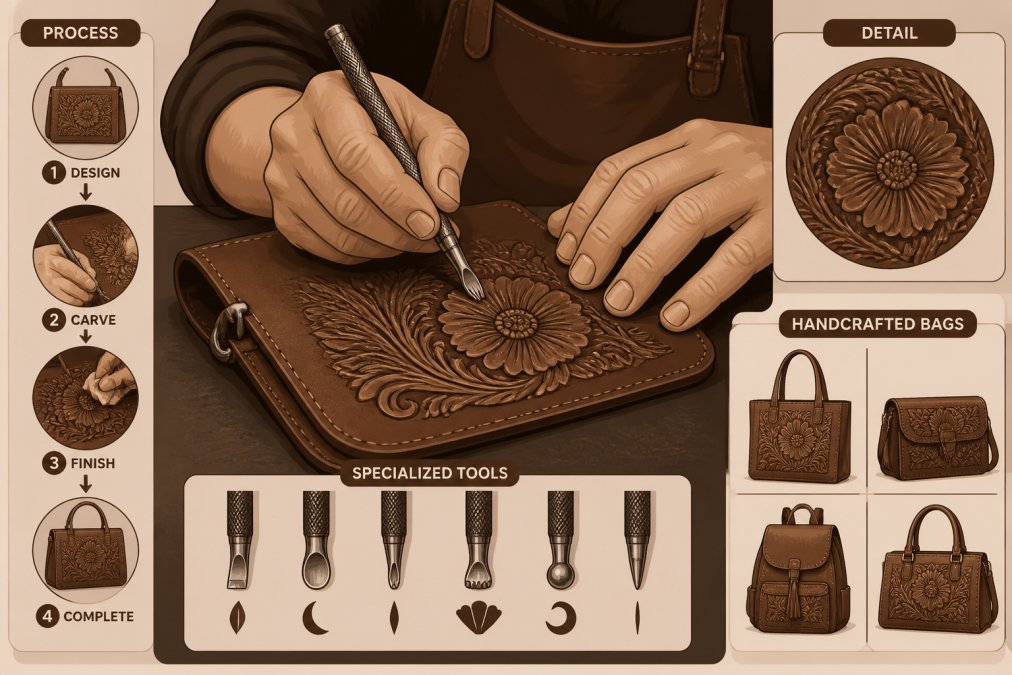
Handmade leather goods start with an artisan's direct involvement in material selection. The maker chooses specific hides based on grain quality, color, and character, cuts patterns by hand, and places each stitch deliberately using saddle stitching techniques. This means no two pieces are identical. Natural variations in the leather become features. Hand-tooling creates intricate designs, and edge finishing is done by hand, creating smooth, refined borders. The result is a bag that develops character over time, with a patina that deepens with use.
What Defines Mass-Produced Leather Bags
Mass-produced leather bags prioritize consistency and speed. Factories source leather in bulk, often using corrected or split leather to maintain uniform appearance and cost. Cutting happens on automated machinery. Assembly line workers perform repetitive tasks. Lock stitching replaces hand-stitching. Quality control focuses on catching defects, not celebrating natural variation. Every bag looks identical, hardware is standardized and cheaper, and edge finishing is minimal or uses chemical treatments rather than hand-burnishing.
Material Quality: Full-Grain Leather vs Corrected and Split Leather
Material choice is where handmade and mass-produced leather bags diverge most dramatically.
Full-grain leather is the top layer of the hide with the grain intact. It retains all natural markings and character, is durable, and ages beautifully, developing a rich patina that makes the bag more attractive over time. Full-grain leather is expensive because it requires careful hide selection and yields less usable material per hide.
Corrected leather has the surface sanded away to remove natural marks, then an artificial grain pattern is stamped on. This allows manufacturers to use lower-quality hides and hide defects. Corrected leather is cheaper and uniform, but doesn't age well, the artificial grain wears away with use.
Split leather is the lower layers of the hide, thinner, weaker, and prone to peeling and cracking. It's the cheapest option and commonly used in mass-produced bags marketed as "genuine leather."
Handmade leather bags almost always use full-grain or vegetable-tanned leather. Mass-produced bags frequently use corrected or split leather to reduce costs.
The Leather Working Group's environmental standards for tanning processes
How to Identify High-Quality Leather Bags
Stitching Techniques: Saddle Stitch vs Lock Stitch
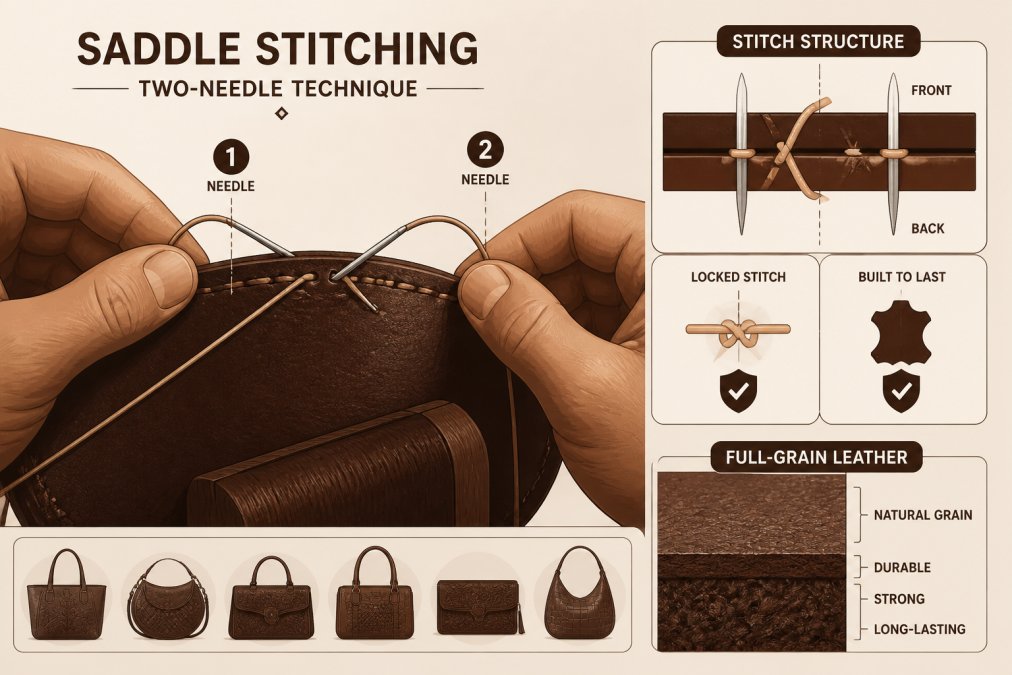
Saddle stitching is the gold standard for leather goods. The artisan uses a two-pointed needle and thread, creating an interlocking pattern where each stitch passes through the previous one. This creates incredible strength, saddle-stitched seams can last decades. Saddle stitching takes time, which is why it's primarily used in handmade bags.
Lock stitching is what machines do. A single needle creates a line of stitches held together by a bobbin underneath. Lock stitching is faster and cheaper, but weaker than saddle stitching. If the thread breaks at one point, the entire seam can unravel.
When you examine a bag, look at the seams. Do you see a double-thread pattern (saddle stitch) or a single line (lock stitch)? Saddle stitching is a reliable indicator of handmade construction.
Hardware Quality and Edge Finishing
Hardware signals quality. Handmade bags use solid brass or gold-tone metal hardware that develops patina alongside the leather. Mass-produced bags use cheap pot metal or plated hardware that tarnishes, flakes, or breaks.
Edge finishing is another tell. In handmade bags, edges are burnished, the leather is smoothed and sealed by hand using tools and sometimes beeswax, creating smooth, refined edges. In mass-produced bags, edges are often left raw, painted with stain, or sealed with chemical finish that can crack or peel. Run your finger along the edge of a bag. Smooth edges indicate handcrafted attention to detail.
Durability and Long-Term Investment Value
A handmade leather bag from full-grain leather can last 20+ years with reasonable care. The leather becomes more beautiful as it ages. Repairs are straightforward, a broken strap can be replaced, a worn zipper can be swapped, stitching can be redone. The bag retains value because the construction quality means it's worth repairing.
A mass-produced bag made from corrected or split leather typically lasts 2-5 years. Once hardware fails or stitching breaks, repair costs often exceed the bag's value. The leather doesn't improve with age; it deteriorates.
A handmade bag at $75-150 worn daily for 15 years costs roughly $0.01-0.03 per wear. A mass-produced bag at $30-50 worn for 3 years costs roughly $0.03-0.05 per wear. The handmade bag is actually cheaper over its lifetime, plus you get a bag that improves rather than degrades.
Benefits of Handcrafted Leather Purses
Artisan Craftsmanship and Attention to Detail
Handcrafted leather purses represent intentionality that mass production can't replicate. An artisan making a bag cares about how it looks, feels, and functions because their name is attached to it. Pockets are positioned where they're useful. Handles are reinforced at stress points. Linings complement the leather. Stitching lines are straight and deliberate. Corners are reinforced.
Handcrafted bags from artisans in traditional leather-working regions, like León, Guanajuato in Mexico, carry generations of technique. These artisans learn their craft over years, often from family members who've been making leather goods for decades. The skill shows in edge finishing, in how leather is cut to minimize waste, and in how hardware is selected and installed.
Customization and Individuality
When you buy a handmade bag, you're often buying from an artisan who can customize it. Want different colors? A different handle style? Custom tooling? An artisan can make those changes. Your bag becomes truly yours, not a mass-produced item that thousands of other people own.
This customization extends to material choices. Handmade makers can source specific leather types, experiment with vegetable-tanned hides, or use vegan leather alternatives. They have flexibility. Mass-produced bags are locked into whatever material the factory has decided to use.
The individuality also comes from natural leather variation. In mass production, variation is treated as a problem to eliminate. In handmade bags, it's celebrated. Your bag is genuinely one-of-a-kind.
Cost Analysis: Upfront Price vs Cost-Per-Wear
The initial price difference is significant. A mass-produced leather bag might cost $30-60. A handmade leather bag typically costs $50-200+. But consider actual use. If you buy a mass-produced bag for $40 and use it for 2 years (roughly 700 days), your cost-per-wear is about $0.06. If it breaks and you replace it, you've bought three bags in 6 years for $120 total.
A handmade bag costs $50-75 for hand-tooled designs or $50 for hand-painted options. Used for 10 years (roughly 3,650 days), your cost-per-wear is $0.01-0.02. Even if you pay $50 for a repair five years in, you're still ahead. A well-maintained handmade bag also retains value if you decide to sell or gift it.

| Factor | Handmade Leather Bags | Mass-Produced Leather Bags |
|---|---|---|
| Upfront Cost | $50-200 | $30-60 |
| Expected Lifespan | 10-20 years | 2-5 years |
| Cost-Per-Wear (daily use) | $0.01-0.03 | $0.03-0.08 |
| Repairability | Excellent (worth fixing) | Poor (rarely worth repairing) |
| Aging Process | Improves with patina | Deteriorates |
| Customization Options | Many | None |
| Resale Value | Moderate to high | Minimal |
Environmental Impact and Ethical Sourcing
Mass production appears efficient, but often relies on cheap leather from questionable sources and can involve environmentally damaging factory tanning. Handmade leather goods, especially from traditional artisan communities, often use vegetable-tanned leather processed using methods refined over centuries. Vegetable tanning uses tree bark tannins instead of chemicals, is environmentally gentler, and produces leather that ages beautifully.
When you buy from an artisan or a brand like Lunas Artisanal Shop that works directly with artisans, your money goes to the maker. You're supporting skilled workers, preserving traditional crafts, and often supporting communities that depend on this work. With mass-produced bags, your money goes to shareholders and factory owners, not the workers assembling the bags.
The Leather Working Group's environmental impact assessment framework
A bag that lasts 15 years and ages beautifully is more sustainable than a bag that lasts 3 years and ends up in a landfill, even if the first one required more upfront resources to make.
Repairability and Maintenance
Handmade leather bags shine in repairability. When a saddle-stitched seam fails, an artisan can re-stitch it. When a handle breaks, it can be replaced. When hardware fails, it can be swapped. These repairs are often affordable because the construction quality means they're worth doing.
Mass-produced bags rarely survive repairs economically. Replacing a zipper on a cheap bag costs nearly as much as buying a new one. Stitching failures are harder to repair because lock stitching is weaker.
Maintenance is straightforward for both. Wipe leather clean with a soft cloth and condition periodically with leather cream. Avoid prolonged sun exposure. The difference is that handmade bags reward this care, they improve. For handcrafted pieces like those from Lunas Artisanal Shop, the care instructions are simple: clean with a dry or slightly damp cloth, condition with leather cream periodically, and avoid prolonged moisture exposure. The leather develops character with proper care, becoming richer and more beautiful over years.
The choice between handmade and mass-produced leather bags reflects what you value. If you want an accessory that lasts, improves with age, and tells a story of craftsmanship, handmade is the answer. For most people who care about quality and sustainability, handmade leather bags from artisans like those at Lunas Artisanal Shop represent better value over time. Their hand-tooled and hand-painted pieces combine traditional craftsmanship with genuine full-grain or premium vegan leather, creating bags that age beautifully and support artisan communities. Shop your story today with pieces designed to last.
Frequently Asked Questions
Are handmade leather bags worth the higher price?
Handmade leather bags often cost more upfront, but the investment pays off through durability and longevity. A handcrafted leather purse made from full-grain leather can last 10-20 years with proper care, while mass-produced bags typically wear out in 2-5 years. When you calculate cost-per-wear over the bag's lifetime, handmade options often become the more economical choice. Plus, handcrafted pieces can be repaired and restored, extending their life further.
How can you tell if a leather bag is truly handcrafted?
Look for these signs of authentic handmade construction: visible hand-stitching with slight irregularities (perfect stitching often indicates machine work), saddle stitching rather than lock stitch, natural leather grain patterns characteristic of full-grain leather, hand-tooled or hand-carved details, and quality hardware that feels substantial. Ask the maker for production details and photos of their workshop. Genuine artisans are transparent about their methods and can prove their leather sourcing and craftsmanship.
What's the difference between full-grain leather and corrected leather?
Full-grain leather retains the hide's natural surface, including grain patterns and imperfections, making each piece unique. It develops a beautiful patina over time and is more durable. Corrected leather has the surface sanded down and artificial grain applied, hiding natural marks. While corrected leather looks uniform, it's thinner, less breathable, and more prone to peeling or cracking. Full-grain leather is the superior choice for bags that will last years and improve with age.
Do handmade leather bags require special maintenance?
Handmade leather bags need basic care: regular cleaning with a soft, dry cloth, occasional conditioning with leather cream to maintain suppleness, and protection from prolonged sun exposure and moisture. The good news is that quality handcrafted pieces are built to withstand daily use. Unlike mass-produced bags that deteriorate quickly, handmade bags actually improve with age, developing a natural patina. If damage occurs, artisan-made bags are often repairable, which extends their lifespan significantly.
Why do handcrafted leather purses last longer than machine-made versions?
Handcrafted leather purses last longer because artisans use superior materials (full-grain leather, quality hardware), employ durable stitching techniques like saddle stitching that distributes stress evenly, and hand-finish edges through burnishing for longevity. Each stitch is placed with intention, and the construction accounts for real-world wear patterns. Mass-produced bags prioritize speed and cost reduction, using thinner leather, cheaper hardware, and assembly-line stitching that fails under regular stress. The craftsmanship difference translates directly to durability.
This article was written using GrandRanker