

Table of Contents
- What Full Grain Leather Actually Is
- Leather Grades Explained: From Full Grain to Bonded
- Full Grain vs Genuine Leather: Why the Difference Matters
- How to Identify Full Grain Leather by Sight and Touch
- Common Myths: The Water Drop Test and Burn Test
- How to Maintain Full Grain Leather So It Ages Beautifully
- Sustainability and Ethical Sourcing in Full Grain Leather
- Conclusion
Last Updated: August 7, 2026
What Full Grain Leather Actually Is
Full grain leather is the highest quality grade of leather available, made from the outermost layer of a hide with the grain side completely intact and unaltered by sanding, buffing, or surface correction. Every natural imperfection, scar, wrinkle, and grain pattern variation remains visible.
This guide from Lunas Artisanal Shop covers how to identify full grain leather, why natural marks are a sign of quality rather than a flaw, and what separates genuinely superior leather from corrected and bonded alternatives flooding the market.
Full grain leather is not just a marketing term. Because the tight, dense fiber structure on the grain side is left completely undisturbed, full grain leather develops a patina over time, deepening in color and character with every year of use. No other leather grade does this the same way. Once you sand or buff that layer, even slightly, you permanently alter the fiber structure, and the leather can never develop the same patina or durability.
According to the Leather Working Group's sourcing standards, the grade and origin of a hide directly affect its environmental impact and longevity, which is why understanding what you are buying matters well beyond aesthetics.
Leather Grades Explained: From Full Grain to Bonded
The leather industry uses a grading system that most consumers never see explained honestly. Four main grades dominate the market, and the differences between them are significant.
Full Grain vs. Top Grain vs. Genuine Leather vs. Bonded
| Leather Grade | Surface Treatment | Patina Development | Durability | Common Use |
|---|---|---|---|---|
| Full Grain | None, grain side intact | Rich, natural patina over years | Highest | Fine handbags, belts, saddlery |
| Top Grain | Lightly sanded, pigmented coating | Minimal | Moderate to high | Mid-range bags, upholstery |
| Genuine Leather | Split layer, heavily corrected | None | Low to moderate | Fashion accessories, wallets |
| Bonded Leather | Leather scraps + adhesive + coating | None | Very low | Low-cost furniture, book covers |
Full grain uses the complete grain side of the hide, untouched. Top-grain leather has been lightly sanded to remove imperfections and receives a pigmented finish coat, but the densest fiber layer is compromised. Genuine leather is a misleading term, it only means the product contains some real leather, typically split leather from the flesh side, heavily corrected with synthetic coatings. Bonded leather is the lowest grade: leather scraps mixed with adhesive, pressed onto fabric backing, and coated with polyurethane. It peels within months of regular use.
Full Grain vs Genuine Leather: Why the Difference Matters
Most people assume "genuine leather" means real, high-quality leather. The opposite is often true.
Full grain and genuine leather represent fundamentally different products. Full grain leather breathes, flexes, and ages naturally. Genuine leather, made from the split layer with a corrected grain surface applied over it, does none of those things reliably.
Full grain leather bags routinely last decades with proper care. Many genuine leather products show surface cracking or peeling within a year or two of daily use, because the synthetic coating delaminates from the underlying split leather. Full grain leather absorbs moisture slowly and releases it as temperature changes, providing breathability. Corrected leather blocks this exchange entirely.
As noted by the American Leather Chemists Association on hide processing standards, the tanning process and degree of surface correction are the two variables that most directly determine a finished leather's performance over time.
How to Identify Full Grain Leather by Sight and Touch
Full grain leather identification does not require a laboratory. The right combination of visual inspection and tactile assessment will tell you almost everything you need to know before you buy.
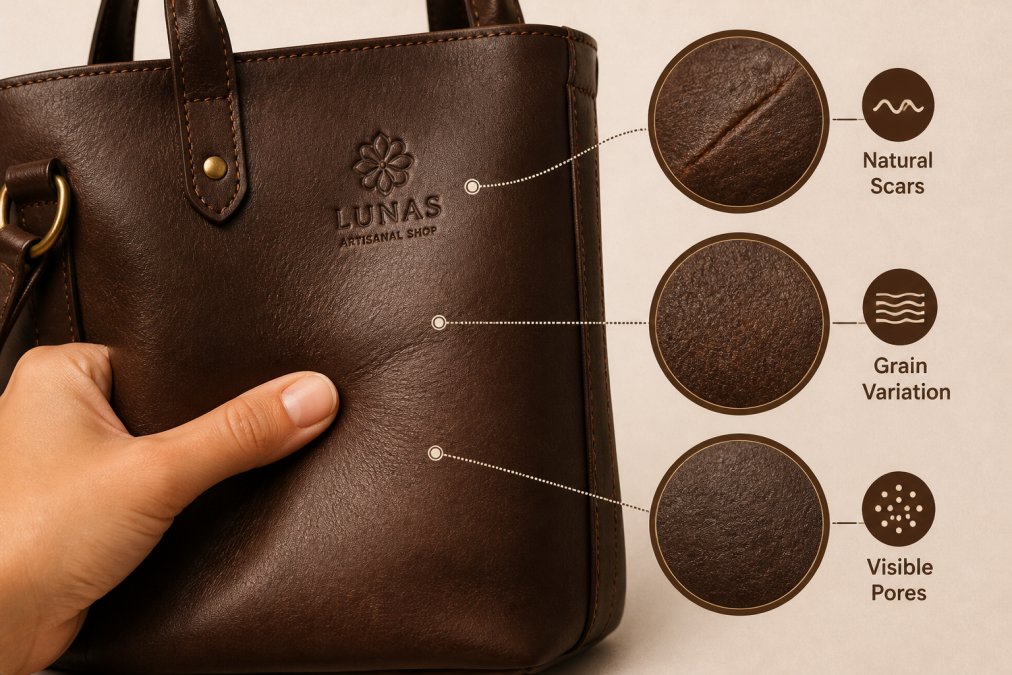
Step 1: Look for Natural Imperfections and Irregular Grain Patterns
A more uniform surface means the leather has been corrected, not that it is better. Full grain leather will show variation across its surface. The grain pattern will not be perfectly regular. You may see subtle differences in density, small healed scars, or faint wrinkle marks. These are proof that the grain side is intact and unaltered.
Corrected grain leather looks almost perfectly uniform because the natural surface has been sanded away and a synthetic grain pattern embossed onto it. If every square centimeter looks identical in texture, it has almost certainly been corrected.
Step 2: Check the Grain Side and Flesh Side
On a finished product, examine the edge or interior to see the cross-section of the leather. Full grain leather shows a tight, dense fiber structure on the grain side, gradually becoming looser toward the flesh side. The flesh side often has a slightly suede-like texture.
Bonded leather shows a clearly artificial backing, often woven fabric or synthetic material, with a thin layer on top. Genuine leather typically looks more uniform throughout, lacking the distinct density gradient of full grain.
Step 3: Assess Breathability and Porosity
Hold the leather close to your face and exhale slowly onto the surface. Full grain leather will respond visibly to moisture, the surface may darken slightly, then return to its original color within seconds. A corrected grain surface or polyurethane-coated product will show no response.
Step 4: Use Macro Photography to Examine Fiber Structure
Smartphone cameras with macro mode or an inexpensive clip-on macro lens reveal surface details the naked eye misses. Under magnification, full grain leather shows an irregular, organic pore structure with genuine three-dimensional depth. Corrected grain leather shows a repeating, embossed pattern that looks mechanical.
Common Myths: The Water Drop Test and Burn Test
Two tests circulate constantly in leather forums: the water drop test and the burn test. Both are misunderstood.
The water drop test assumes real leather absorbs water quickly while fakes repel it. Vegetable tanned full grain leather absorbs water readily, but chrome tanned full grain leather absorbs more slowly because the tanning process affects porosity differently. The test cannot confirm leather grade on its own.
The burn test requires you to actually burn the product you are evaluating, destroying it in the process. Results are unreliable for semi-aniline and pigmented leathers that have surface coatings, which includes many legitimate full grain products.
According to the Consumer Product Safety Commission's guidance on material testing, burning materials for identification at home carries real risks and should not be treated as standard consumer practice.
Rely instead on visual grain irregularity, porosity, edge cross-section, and macro photography. These methods are non-destructive, repeatable, and far more accurate.
How to Maintain Full Grain Leather So It Ages Beautifully
Full grain leather requires less maintenance than most people assume, but the care you give it directly shapes the patina it develops over years.
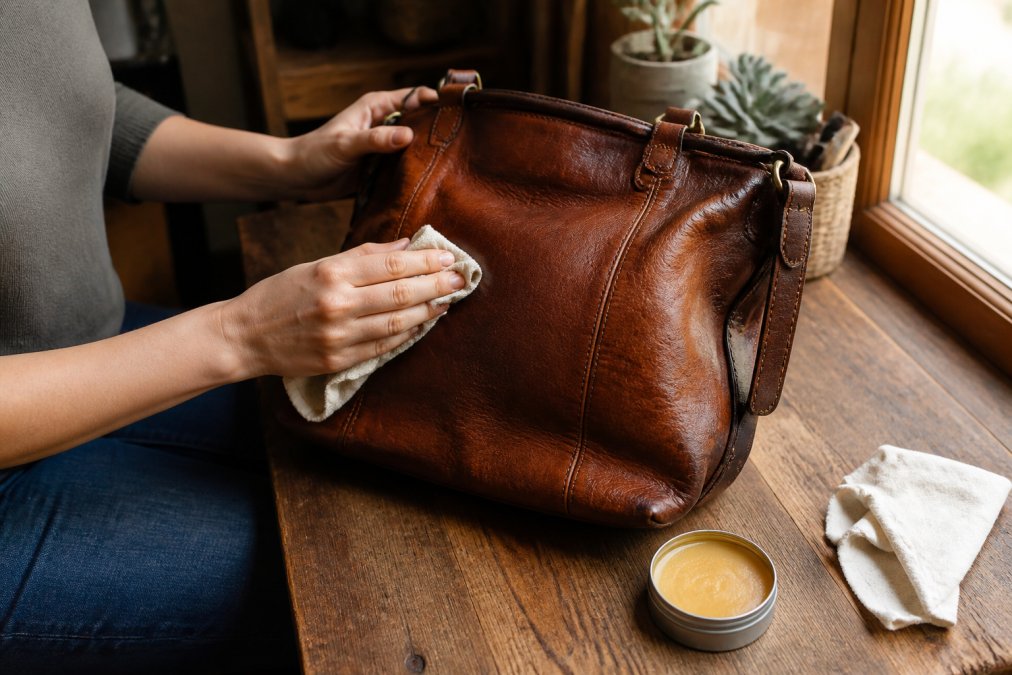
Full grain leather needs moisture to stay supple and protection from elements that strip that moisture away. Heat, direct sunlight, and prolonged water exposure are the primary threats.
A practical maintenance checklist:
- Condition the leather every 3-6 months with a product designed for aniline or full grain leather
- Apply conditioner with a soft cloth using circular motions, then allow it to absorb fully before buffing
- Store the bag stuffed with tissue paper to maintain its shape, away from direct sunlight
- If the leather gets wet, blot it dry immediately and allow it to air dry at room temperature
- Clean surface dirt with a slightly damp cloth before conditioning, never with soap or alcohol-based cleaners
- Rotate use across multiple pieces to allow the leather to rest and breathe between wears
The patina that develops on well-maintained full grain leather is a physical change in the surface oils and fiber structure that actually makes the leather more resistant to moisture and abrasion over time. A bag that looks better at ten years than it did at one is the hallmark of genuine full grain leather.
At Lunas Artisanal Shop, every handcrafted leather bag is made to be lived in and aged beautifully. The artisan-quality full grain leather used in each piece is selected to develop character with daily use.
Sustainability and Ethical Sourcing in Full Grain Leather
Full grain leather is, by definition, the most efficient use of a hide. Because the grain side is left intact and unaltered, there is no sanding waste, no chemical correction process, and no synthetic coating required.
This matters for sustainability in two ways. First, full grain leather lasts significantly longer than corrected or bonded alternatives, which means fewer products entering the waste stream over a consumer's lifetime. A well-maintained full grain bag that lasts 20 years has a fundamentally different environmental footprint than three or four lower-grade bags purchased and discarded over the same period.
Second, the tanning process is a meaningful variable. Vegetable tanned leather uses plant-based tannins derived from bark and other natural sources, and is considerably less chemically intensive than chrome tanning. Many artisan leather producers still use vegetable tanning methods refined over generations.
Choosing full grain leather from producers with transparent sourcing practices is one of the most concrete ways a consumer can make a more sustainable choice. The Leather Working Group certification provides a framework for evaluating tannery environmental performance worth looking for when a brand makes sustainability claims.
Lunas Artisanal Shop sources leather through Mexican artisan networks with deep roots in traditional craft, where the relationship between maker and material is direct and traceable.
Identifying full grain leather confidently takes practice, but the core signals are consistent: irregular grain patterns, visible natural imperfections, open porosity, and a cross-section showing dense fiber structure on the grain side. Once you know what to look for, the difference between genuine full grain and corrected alternatives becomes unmistakable. Lunas Artisanal Shop brings handcrafted artisan leather directly from Mexican craftspeople to your everyday style. Shop your story today.
Frequently Asked Questions
How can you tell if leather is full grain?
Full grain leather keeps the outermost layer of the hide intact, so the surface shows natural imperfections: small scars, wrinkles, and an irregular grain pattern that varies across the piece. Run your fingers across it, the texture should feel slightly uneven and breathable, not perfectly smooth or plastic-like. Under a smartphone macro lens, you'll see an open pore structure. Corrected grain leather, by contrast, has been sanded and embossed with a uniform pattern, making it look suspiciously flawless.
Does full grain leather have imperfections?
Yes, and those imperfections are a sign of authenticity, not poor quality. Because full grain leather is never buffed or sanded, natural marks from the animal's life, insect bites, stretch marks, healed scars, remain visible on the grain side. These variations confirm that the outermost layer of the hide is intact. Over time, those same characteristics contribute to the unique patina that makes each full grain leather piece one of a kind.
What does genuine leather mean vs full grain?
Genuine leather is a broad, legally permitted label that covers almost any product made from real hide, including low-grade split leather, the fibrous inner layers left after the top surface is separated. It tells you very little about quality. Full grain leather, by contrast, specifies that the outermost, densest layer of the hide is present and unsanded. Full grain is the highest leather grade; genuine leather is closer to the bottom of the scale, often pigmented heavily to hide inconsistencies.
Can you test leather with a water drop test?
The water drop test, where you place a small drop of water on the surface and watch absorption, is widely shared online but not reliable on its own. Full grain leather does absorb water due to its open pore structure, but so can some treated top-grain leathers. Heavily pigmented or wax-finished full grain hides may bead water initially. Use the water drop test as one signal among several, not a definitive proof. Grain pattern irregularity and visible natural scars are far more trustworthy indicators.
This article was written using GrandRanker