

Table of Contents
- How Fair Trade Accessories Create Change for Artisans
- The Benefits of Fair Trade Fashion for Producers and Consumers
- How to Identify Authentic Fair Trade Products
- The Impact of Sustainable Leather Goods on Communities and the Planet
- Verifying Fair Trade Claims: Transparency vs. Greenwashing
- The Cost-per-Wear Argument: Why Fair Trade Accessories Make Economic Sense
- Frequently Asked Questions
Last Updated: September 19, 2026
How Fair Trade Accessories Create Change for Artisans
Fair trade accessories are handcrafted goods produced and traded under certification standards that guarantee fair pricing, safe working conditions, and community investment for the makers behind them. At Lunas Artisanal Shop, we source hand-carved leather and loom-woven pieces directly from Mexican artisans, so we see what that model changes on the ground.
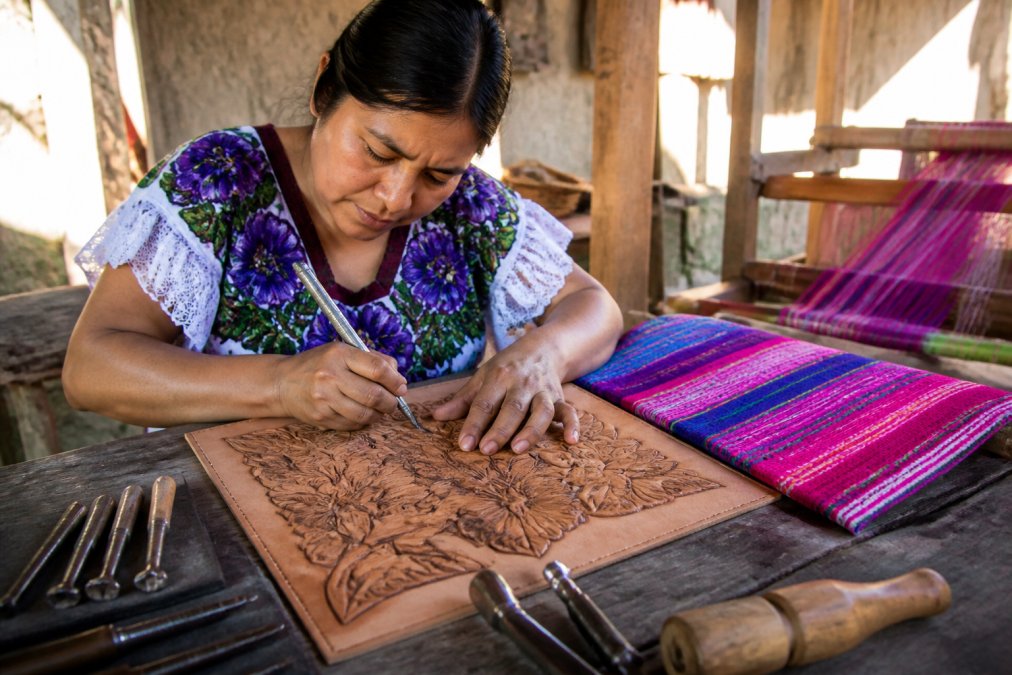
The core mechanism is simple: a guaranteed minimum price and a social premium paid on top of it. That premium funds schools, clinics, tools, and training in the communities where the work happens.
The Social Premium and Community Development
The social premium is an extra sum paid by buyers, on top of the purchase price, that producer cooperatives vote on how to spend. It is not a donation and it is not charity. It is a structural payment that turns individual sales into community development, funding everything from clean water to capacity building for younger makers.
The Benefits of Fair Trade Fashion for Producers and Consumers
The benefits of fair trade fashion run in two directions at once, but they are not symmetrical, and understanding the asymmetry is what separates a real impact story from a marketing one. Producers gain predictable income, safer working conditions, and a route out of the cycle of poverty. Consumers gain traceability, durable goods, and a purchase that aligns with their values without sacrificing quality.
Economic Empowerment and Living Wages
A living wage is the amount a worker needs to cover housing, food, healthcare, and education for a family in their own region. Fair trade certification standards push buyers toward that number rather than whatever the local market will bear. When artisans earn a living wage, they gain purchasing power, and that money circulates through the local economy.
The Consumer-Side Benefit Is Durability, Not Virtue
The honest consumer benefit is not a feeling. It is a longer service life. Hand-stitched construction, reinforced hardware, and full-grain or vegetable-tanned leather all extend how long an accessory stays in rotation, which is the variable that actually determines whether a purchase was cheap or expensive. That is the bridge to the cost-per-wear argument later in this article, and it is the reason fair trade accessories can compete on economics rather than only on ethics.
Environmental Stewardship in Practice
Environmental stewardship in fair trade production shows up in specific choices, not slogans. Vegetable-tanned leather avoids the heavy metals used in some industrial tanning. Natural dyes replace synthetic ones. Small-batch production wastes less material than factory-scale runs. These are not abstract commitments; they change what ends up in soil and water near the workshop.
How to Identify Authentic Fair Trade Products
Authentic fair trade products carry third-party certification, a named producer group, and a supply chain the seller can explain. If a brand cannot tell you who made the item and under what conditions, the "fair trade" label is marketing, not a guarantee.
Certifications That Matter
Several certification bodies verify fair trade claims, and each covers a different part of the supply chain:
- Fair Trade Certified: covers agricultural and manufactured goods, with audits of working conditions and premium payments
- Fairtrade International: the global standard, with separate producer and trader requirements
- World Fair Trade Organization (WFTO): verifies that an entire business model, not just one product line, meets fair trade principles
- B Corporation certification: measures social and environmental performance across the whole company
The Impact of Sustainable Leather Goods on Communities and the Planet
The impact of sustainable leather goods starts with the tanning method and ends with how long the item stays in use. Most fair trade content stops at the first half of that sentence. The second half, the full lifecycle of the accessory, is where the real environmental and community math lives, and it is the part almost no competitor covers.
Stage 1: Raw Material and Tanning
Vegetable-tanned leather, which uses plant-based tannins instead of chromium, is the standard most artisan workshops follow because it is safer for the people handling it and gentler on the surrounding environment. Chromium tanning is faster and cheaper, which is why it dominates industrial production, but it generates wastewater that requires treatment and exposes tannery workers to chemicals that require protective equipment.
Stage 2: Production and the Workshop Floor
Small-batch production wastes less material than factory-scale runs because cutting is done by hand around the hide rather than by a machine optimizing for speed. The trade-off is labor intensity: hand-cutting is slower, which is part of why the item costs more. That cost is the mechanism, not a markup. It is the difference between a workshop where one person makes one bag and a factory where one person performs one step on hundreds of bags.
Stage 3: Use Phase, The Longest Stage
The use phase is where most of an accessory's environmental impact is either avoided or incurred. A bag worn three times a week for five years displaces multiple cheaper bags that would have been manufactured, shipped, and discarded in the same period. Every replacement avoided is a full production cycle avoided. This is why durability is an environmental argument, not just an economic one, and why the cost-per-wear framing later in this article is also a lifecycle framing.
Stage 4: End of Life
Leather and woven natural-fiber accessories biodegrade far more readily than synthetic alternatives, but the more important end-of-life outcome is repair. A hand-stitched bag can be re-stitched. Hardware can be replaced. A mass-produced bag with glued construction usually cannot be repaired economically, which sends it to landfill. Buyers who ask 'can this be repaired?' before purchase are making a lifecycle decision, whether they use that language or not.

Traceability Is the Thread That Connects the Stages
When a bag can be traced back to a specific workshop, the buyer can confirm that fair pricing and safe working conditions reached the maker. That is supply chain accountability in practice, and it is what separates a genuine artisan product from a mass-produced item with a heritage-themed label. Traceability is also what makes the lifecycle claim verifiable: without knowing the tannery and the workshop, a buyer cannot assess any of the four stages above.
| Claim Type | What to Verify | Where to Check |
|---|---|---|
| Fair trade certified | Certificate number and scope | Certifier's public database |
| Genuine leather | Tanning method and origin | Seller's material documentation |
| Handmade | Named workshop or artisan group | Direct seller disclosure |
| Sustainable materials | Fiber or tannin source | Supplier transparency report |
| Repairable | Stitching method and hardware availability | Seller's repair policy |
Verifying Fair Trade Claims: Transparency vs. Greenwashing
Greenwashing is the practice of making a product look more ethical than it is, usually through vague language and unverifiable claims. The fix is not cynicism; it is asking for specifics. A brand that can name its workshop, its tannery, and its certifier is almost never greenwashing. A brand that only offers adjectives usually is.
The Cost-per-Wear Argument: Why Fair Trade Accessories Make Economic Sense
Cost-per-wear is the purchase price divided by the number of times you actually use the item. A $55 handcrafted leather bag worn three times a week for five years costs pennies per wear. A cheaper bag that peels after six months costs far more per use, even though it was less expensive at checkout.

- Cheap bag, replaced twice a year: highest cost-per-wear
- Mid-range bag, replaced every two years: moderate cost-per-wear
- Handcrafted leather bag, used for years: lowest cost-per-wear
Frequently Asked Questions
What impact does fair trade certification have on artisan communities?
Fair trade certification guarantees artisans receive a living wage, safe working conditions, and a social premium reinvested into community projects like education and healthcare. For accessories, this means your purchase directly supports economic stability, gender equality, and capacity building for marginalized producers. Certification also enforces child labor prevention and environmental stewardship, creating a cycle of sustainable livelihoods rather than one-time transactions.
How can consumers verify the impact of fair trade claims?
Look for third-party certifications, such as the World Fair Trade Organization (WFTO) logo. These organizations audit supply chains for transparency, traceability, and fair pricing. Brands should also publish impact reports detailing how much artisans earn and where social premium funds go. If a company makes vague claims without certification or specific data, treat it as greenwashing until proven otherwise.
What are the environmental impacts of supporting fair trade fashion?
Fair trade fashion reduces environmental impact through sustainable material sourcing, low-impact dyes, and small-batch production that minimizes waste. Artisan-made accessories often use vegetable-tanned leather and natural fibers, avoiding toxic chromium and synthetic chemicals common in mass production. Supporting these practices also preserves traditional techniques that rely on renewable resources and local ecosystems, lowering the carbon footprint of your wardrobe.
Are fair trade accessories more durable than mass-produced alternatives?
Yes, artisan-crafted accessories typically use higher-quality materials and construction methods that extend product lifespan. For example, hand-carved leather and backstrap loom weaving create stronger, more resilient pieces than factory-made equivalents. This durability means fewer replacements, better cost-per-wear, and less waste over time. Investing in one well-made fair trade bag often outlasts several fast-fashion versions.
The challenge with fair trade is that the label alone tells you very little; the proof lives in the supply chain behind it. Lunas Artisanal Shop answers that by sourcing 100% genuine leather accessories handcrafted in Mexico, from hand-carved floral designs to authentic Chiapas loom weaving, and by naming the artisans behind each piece. If you want accessories that carry a real story and hold up to daily use, browse the collection and shop your story today.