

Table of Contents
- What Is Top Grain Leather? A Plain-English Explanation
- How the Hide Gets Split Into Layers
- Full Grain vs Top Grain Leather: What Actually Changes
- Top Grain vs Genuine Leather: Why the Label Misleads Buyers
- How to Tell Top Grain Leather Apart in Person
- Benefits of Handcrafted Leather Purses Over Mass-Produced Bags
- How to Care for Top Grain Leather Handbags
- Does Top Grain Leather Peel, and Can It Be Repaired?
- Conclusion
- Frequently Asked Questions
Last Updated: September 27, 2026
What Is Top Grain Leather? A Plain-English Explanation
Top grain leather is the outer surface of an animal hide after the very top layer has been sanded away to remove scars, bites, and other natural markings, leaving a smooth, uniform surface that takes dye evenly and resists visible wear. This guide from Lunas Artisanal Shop explains what the label means, how the hide is split, and how to spot real top grain leather in person.
How the Hide Gets Split Into Layers
A cowhide is thick, and almost nothing is made from its full thickness. Tanners run it through a splitting machine that peels it horizontally into layers. The outermost layer faced the weather, with the tightest fiber strength and the natural grain pattern the animal grew. Everything below it is softer and weaker.
That outermost layer gets divided again by surface treatment:
- Full grain: the outer layer left intact, markings and all
- Top grain: the outer layer sanded and buffed to remove those markings
- Corrected grain: heavily sanded, then embossed with a fake grain pattern
- Split leather: the lower layers, which have no grain at all until one is stamped on
Full Grain vs Top Grain Leather: What Actually Changes
The difference between full grain and top grain leather comes down to surface, not strength. Both come from the outermost layer; top grain is sanded to remove natural markings, while full grain keeps them.
In practice, that means:
- Appearance: full grain shows scars, veins, and insect bites; top grain looks uniform
- Dye absorption: top grain takes an even color; full grain dyes unevenly by nature
- Break-in: full grain molds to use; top grain holds its shape
- Cost: top grain is usually cheaper because more hides pass inspection
Durability, Patina, and Breathability Side by Side
| Factor | Full Grain | Top Grain |
|---|---|---|
| Source layer | Outermost layer, intact | Outermost layer, sanded |
| Natural markings | Visible | Removed |
| Patina development | Develops over years | Minimal |
| Breathability | High, grain open | Moderate, grain sealed |
| Tensile strength | Highest | Nearly equal |
| Appearance | Unique per hide | Uniform |
| Typical price | Higher | Lower |
Patina is the biggest real difference. Full grain darkens and develops a sheen as oils work into the open grain. Top grain, especially with a pigmented finish, stays closer to its original color for life. Neither is better: for a bag that looks the same in year five, top grain is the smarter buy; for one that looks better, go full grain.
Top Grain vs Genuine Leather: Why the Label Misleads Buyers
Genuine leather is the lowest grade in the trade, and the label is deliberately vague. It is a legal term, not a quality term. Any product containing real animal hide can be called genuine leather, including split leather bonded and stamped to look like grain.
What the words usually mean on a real tag:
- Full grain: outer layer, unsanded, highest durability
- Top grain: outer layer, sanded smooth, still strong
- Genuine leather: often split leather or a thin shaved layer, weakest
- Bonded leather: leather fibers glued together, not a hide at all
Marketing Jargon vs Industry Standard Terminology
The gap is widest with "genuine." In tannery language, genuine simply means real. In retail language, it has become a way to charge more for the cheapest material available.
How to Tell Top Grain Leather Apart in Person
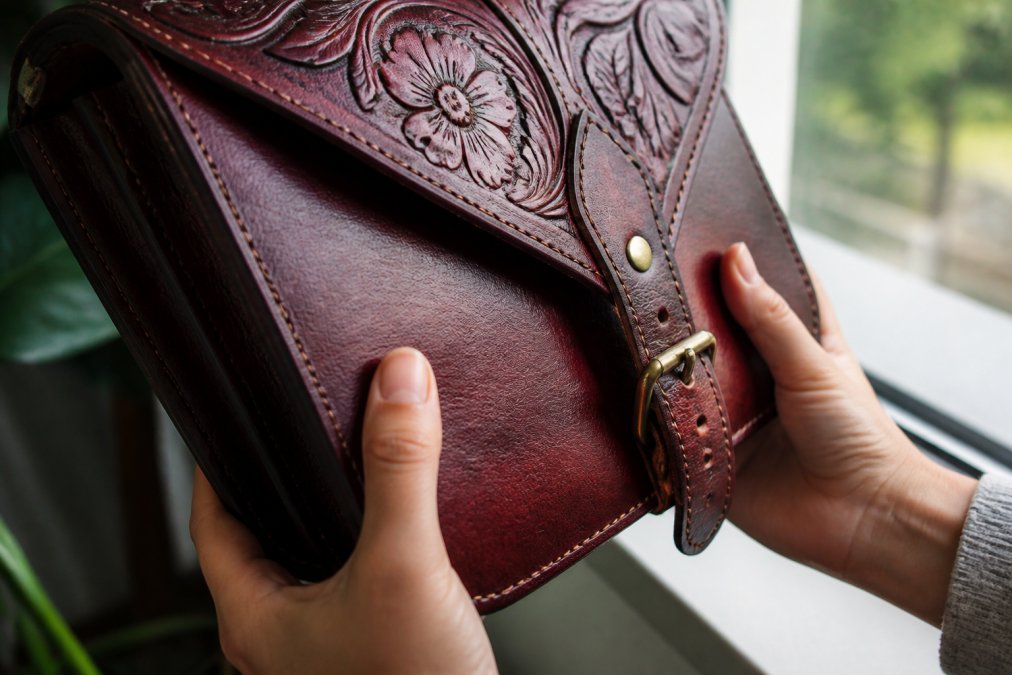
You can identify top grain leather in about thirty seconds with your hands and a light source. The surface feels smooth and slightly matte, shows a fine even texture under raking light, and springs back when you press a fingernail into it. But the fastest method is visual: get close enough to read the grain.
The Macro Identification Protocol
Most guides tell you to "look at the grain." Here is what to look for, in order:
- Grain pattern at close range. Real top grain shows a fine, irregular, non-repeating pattern of pores and creases that shifts as you move the piece. An embossed or corrected grain repeats the same motif in a grid across the whole panel, the single clearest tell.
- Pore structure. Under a phone camera zoomed in or a jeweler's loupe, genuine grain shows hair follicle pores of varying size and spacing. A stamped pattern has uniform, mechanical pores or none at all.
- Edge cross-section. Top grain shows a solid, dense fibrous cross-section uniform through the thickness. Split leather looks like a sandwich, with a thin finished skin bonded to a looser, fuzzier core. Bonded leather looks crumbly, like particle board.
- Crease behavior. Press a thumbnail in and release. Real top grain creases into fine radiating lines and recovers. Corrected grain and bonded leather dent flat, crack, or show a white stress line where the coating separates.
- Light test. Tilt the piece toward a window. Natural grain shifts and varies in sheen; an embossed pattern reflects identically across the whole panel.
The Hand and Nose Checks
- Smell test: real tanned hide smells like leather; plastic-heavy finishes smell like vinyl or glue. A fast filter, not a final verdict, since some quality finishes are nearly odorless.
- Temperature and drape: real leather warms to the touch and drapes with weight. Bonded leather feels cool and stiff or unnaturally light.
- Stretch and recovery: gently pull a hidden edge. Top grain stretches slightly and returns. Split and bonded leather either will not stretch or stays stretched.
What These Checks Cannot Tell You
None of these tests reliably distinguish full grain from top grain, because both come from the same outer layer and show real grain. Top grain has been sanded, so its grain is finer and more uniform than full grain's, which keeps the scars, veins, and insect bites. If a seller claims full grain, look for those markings; their absence is a hint, not proof, that the hide was sanded.
Benefits of Handcrafted Leather Purses Over Mass-Produced Bags
Handcrafted leather purses typically outlast mass-produced bags because the maker controls the hide, the stitching, and the hardware. A small workshop cuts around weak spots. A factory line cuts for maximum yield per hide.
Arizona — Long Bifold Genuine Leather →
That difference shows up in three places:
- Hide selection: artisans reject hides with weak fiber, factories use them
- Stitching: hand-finished seams can be repaired; glued and machine-tacked seams cannot
- Hardware: solid brass and reinforced anchors versus plated pot metal
How to Care for Top Grain Leather Handbags
Top grain leather handbags need moisture control, occasional conditioning, and protection from prolonged sun. But the correct routine depends on the finish on top of the grain, which most care advice ignores. A pigmented top grain bag and an aniline top grain bag are both "top grain," yet they fail in opposite ways and need opposite products.
Match the Care to the Finish
Top grain leather comes in three finish families, each behaving differently:
- Aniline (unfinished or lightly finished): dye soaks into the grain with no protective topcoat. The open surface absorbs oils, darkens with handling, and spots if liquid sits on it. Most breathable, most fragile.
- Semi-aniline: a thin protective coat over dyed grain. Some breathability, some stain resistance, moderate patina. The most common finish on quality top grain bags.
- Pigmented: a heavier opaque coating that hides the grain and gives uniform color. Maximum stain and scuff resistance, minimum breathability, almost no patina. Most often confused with corrected grain.
A Finish-Aware Routine
- Weekly: wipe with a dry microfiber cloth to remove dust and body oils, often all a pigmented finish needs.
- Monthly to quarterly: condition with a leather cream. Aniline and semi-aniline need it more often; pigmented finishes sparingly, since the coating already blocks moisture loss.
- Seasonally: apply protective spray only on aniline or semi-aniline, and only if the manufacturer recommends it. Never spray pigmented leather; it can cloud the coating.
- Always: store stuffed and upright in a breathable cotton bag, never plastic. Plastic traps humidity and invites mildew in the fiber.
Skip saddle soap unless the leather is genuinely dirty. It is alkaline, and repeated use pushes the leather's pH upward, stripping the finish and accelerating drying and cracking. If you must clean, use a pH-balanced leather cleaner, then condition.
Why pH and Water Matter More Than Most People Think
Leather is a protein fiber that sits naturally in a mildly acidic range. Alkaline cleaners, hard water, and some household soaps raise the pH and break down the oils that keep the fiber supple, the mechanism behind the cracked, brittle bag that was "cleaned" weekly. Over-cleaning often causes more damage than under-cleaning. If the bag gets wet, blot it and air dry away from heat; a radiator or hair dryer cracks the surface within hours.
Does Top Grain Leather Peel, and Can It Be Repaired?
Top grain leather does not peel. What peels is a corrected grain or split leather finish, where a plastic coating sits on a weak surface and lifts away. Real top grain has no coating layer to separate.
Leather repairability depends on what failed:
- Surface scuffs: buffed out with conditioner and a soft cloth
- Deep scratches: filled by a leather repair specialist, usually invisible afterward
- Loose stitching: re-stitched by hand, straightforward on a hand-finished seam
- Torn panels: replaceable, but only if the hide is thick enough to hold new stitches
- Peeling coating: not repairable, the finish has failed structurally
Conclusion
Buying leather is an exercise in reading past the label. Top grain, full grain, and genuine leather describe how a hide was treated, not how long it will last.
Frequently Asked Questions
Is top grain leather considered real leather?
Yes. Top grain leather comes from the top layer of the animal hide, just below the hair. It is real leather in the truest sense, made from the same outer surface as full grain. The difference is that top grain gets sanded or buffed to remove surface imperfections, then often receives a pigmented finish. What it is not is bonded leather, which is shredded leather fibers glued onto a backing and is the material most likely to peel.
What is the difference between full grain and top grain leather?
Full grain keeps the outermost layer of the hide completely intact, including natural markings and the tight grain pattern. Top grain has that same top layer sanded or buffed to even out scars, insect bites, and color variation, then finished. Full grain develops a patina and shows character over time; top grain looks more uniform from day one and resists staining better.
Does top grain leather peel over time?
Top grain leather does not peel the way bonded or heavily corrected leather does, because it is still a solid piece of hide rather than a coating over shredded fibers. What can happen is the pigmented surface finish wearing thin in high-friction spots after years of use, especially if the leather dries out. Conditioning top grain leather handbags two to three times a year keeps the finish supple and dramatically reduces that risk.
Is top grain leather durable for everyday handbags?
It handles daily use well. The top layer of a hide has dense, tightly packed fibers, so a top grain bag resists scuffing and holds its shape through years of commuting and travel. A structured satchel made from 100 percent genuine leather in León, Guanajuato, like the Colibrí hand-tooled floral satchel at $65, shows how that durability pairs with artisan finishing.