

Table of Contents
- What You'll Need Before You Start Checking
- How to Tell If a Bag Is Real Leather: The Five Clues That Matter
- Genuine Leather vs. Faux Leather: What the Difference Actually Looks Like
- Genuine Leather Label Meaning: Grades, Terms, and Misleading Claims
- How to Check Leather Quality: Patina, Lining, and Long-Term Wear
- How to Identify Genuine Leather Handbags When Shopping Online
- A Reliable Verification Workflow (and the Limits of Visual Tests)
- Common Mistakes People Make When Testing Leather
- Frequently Asked Questions
Last Updated: October 6, 2026
What You'll Need Before You Start Checking
You do not need a lab to tell real leather from plastic, just good light, clean hands, and a few minutes.
Learning how to identify genuine leather handbags takes about five minutes once you know what to look for. The clues are physical: the smell, the surface, the edges, and how the material responds to a single drop of water.
Gather these before you start:
- Good daylight or a bright lamp
- Dry, clean hands with no lotion
- A small cup of water and a cotton swab
- A magnifying glass or your phone camera zoom
- The bag's tag, label, or product listing
How to Tell If a Bag Is Real Leather: The Five Clues That Matter
Real leather shows natural variation; faux leather shows repetition. That contrast explains almost every test below.
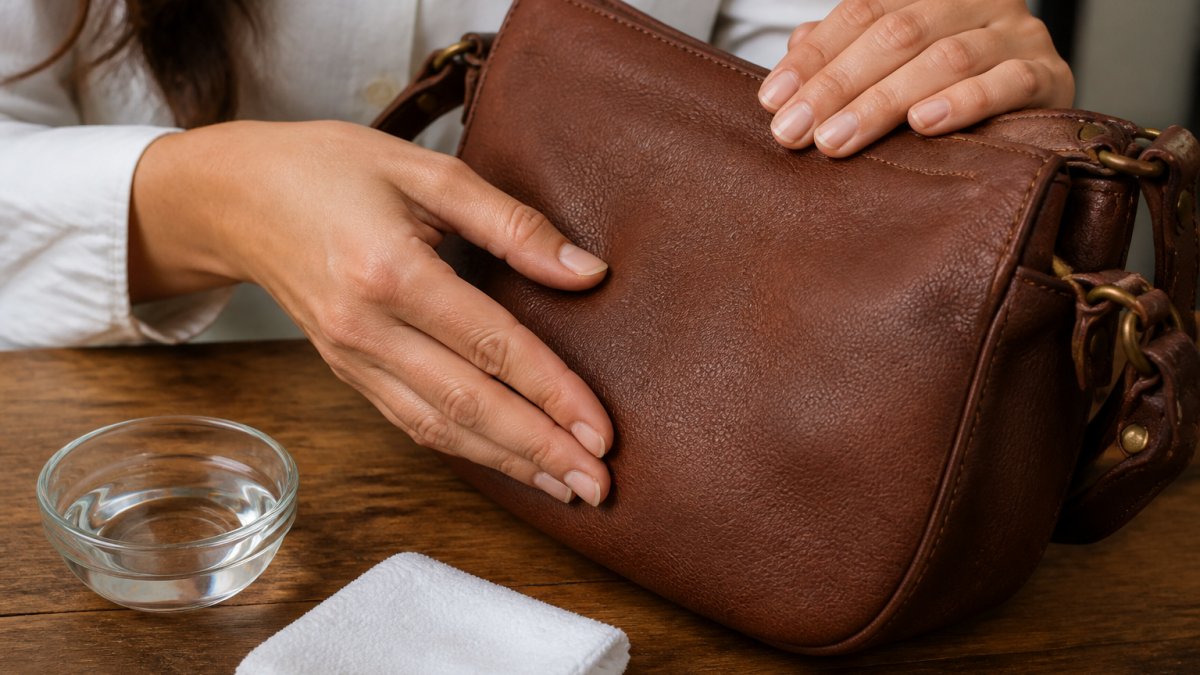
Smell, Touch, and Surface Grain
Genuine leather smells earthy and warm, like a saddle or leather jacket. Faux leather smells like plastic, glue, or nothing.
Touch matters too. Real leather feels soft and slightly cool, warming to your hand.
Then look at the grain. Real leather grain is uneven, with slight differences in pore size and texture across the panel. Faux leather repeats the same pattern forever, like wallpaper.
Edges, Stitching, and the Water Drop Test
Cut edges are the fastest giveaway. Real leather's raw edge looks fibrous and dense, like felt; faux leather often shows a fabric backing or plastic core.
Check the stitching next. Even, reinforced stitching at stress points signals a well-built bag; loose or crooked stitching means the maker cut corners everywhere.
For the water drop test, place one drop on the surface. Real leather absorbs it slowly and darkens slightly; faux leather beads the water on top and wipes clean.
Genuine Leather vs. Faux Leather: What the Difference Actually Looks Like
The difference is simple: one is animal hide, the other a manufactured material, usually polyurethane or PVC bonded to a fabric backing.
That difference shows up in how each ages. Real leather develops a patina, darkening, softening, taking on character. Faux leather cracks, flakes, and peels, often within a year of daily use.
Here is a side-by-side breakdown:
| Clue | Genuine Leather | Faux Leather |
|---|---|---|
| Smell | Earthy, natural | Plastic or chemical |
| Grain | Uneven, unique | Repeats evenly |
| Edges | Fibrous, dense | Fabric or plastic core |
| Water drop | Absorbs, darkens | Beads on top |
| Aging | Develops patina | Cracks and peels |
Durability is where real leather wins outright: a well-made leather bag lasts years with basic care, while faux leather is disposable no matter how good it looks on day one.
Genuine Leather Label Meaning: Grades, Terms, and Misleading Claims
The word "genuine" on a label does not mean premium. Under U.S. Federal Trade Commission guidance, calling a product leather means it is made from animal hide, but says nothing about which layer was used, how thick it is, or how long it will last. That is why two bags can both say "genuine leather" and behave completely differently after a year.
Here is the grade ladder, from strongest to weakest:
| Grade | What it is | Durability | Typical use |
|---|---|---|---|
| Full-grain | Top layer of the hide, grain intact, minimal finishing | Highest, develops patina | Premium bags, belts, boots |
| Top-grain | Top layer, sanded and finished to remove imperfections | High, less breathable | Mid-to-premium bags |
| Corrected-grain | Top layer, heavy sanding plus embossed fake grain | Moderate, coating can crack | Mass-market bags |
| Split | Lower layers of the hide, often finished with a coating | Lower, weaker fiber structure | Budget bags, linings |
| Bonded | Leather scraps ground up and glued with binder | Lowest, can delaminate | Cheap bags, book covers |
A few clarifications:
- "Genuine leather" is a real grade, not a synonym for full-grain. It usually means a split or corrected layer sanded and finished to look uniform, real hide, but thin and less durable.
- "Full-grain" is the top of the ladder. The natural grain is intact, making the surface the strongest part of the hide. It is the most expensive and most likely to develop a rich patina.
- "Top-grain" is not the same as full-grain. It is sanded to remove scars and blemishes, looking cleaner but losing some breathability.
- "Split" comes from the lower layers. Its looser fiber structure stretches and sags faster than the top layer.
- "Bonded" is mostly glue. Scraps are shredded, mixed with a binder, and pressed into sheets. It can peel in layers.
Now the misleading phrases that show up in listings and on hangtags:
- "Genuine leather" alone, with no grade named, real, but usually a lower grade.
- "Leather-like," "leatherette," "pleather," "vegan leather", not animal hide. These are coated fabrics, typically polyurethane (PU) or polyvinyl chloride (PVC) on a backing.
- "PU leather" or "faux leather" in fine print, synthetic. PU is more flexible and breathes slightly better than PVC; PVC is cheaper and stiffer.
- "Made with leather" or "leather trim", some parts are hide, others are not. Ask which parts.
- "Bicast" or "bicast leather", a split or reconstituted base with a heavy polyurethane coating. It can look like leather but the top layer is plastic.
- "Plant-based leather," "cactus leather," "mushroom leather," "apple leather", these are emerging alternatives, not animal hide. They may be durable, but they are not leather in the FTC sense, and labeling rules still apply.
One more thing: a high price does not guarantee a high grade. Corrected-grain and bonded leather can carry premium price tags when branding is strong. The grade name, or its absence, is the better signal.
How to Check Leather Quality: Patina, Lining, and Long-Term Wear
Quality leather changes over time. Cheap leather hides its flaws until the coating fails.
Patina is the shine and depth real leather builds with use, from oils in your hands and exposure to air.
Valeri — Two-Tone Genuine Leather Handbag | Bolsa de Piel Genuina Bicolor →
Check the inside too. A quality bag has a sturdy lining, often cotton canvas or soft microfiber; cheap bags use thin polyester that tears at the seams.
Look at the hardware too. Solid metal zippers and clasps last. Painted plastic ones chip and jam.
At Lunas Artisanal Shop, our satchels use reinforced double top handles and interior zip closures, details that hold up to daily use. For example, the Escama satchel pairs a hand-chiseled scale pattern with an internal zippered pocket for valuables.

How to Identify Genuine Leather Handbags When Shopping Online
Online shopping removes smell and touch, so you have to work from photos, labels, seller disclosures, and return policies.
Start with the listing text. Search for the words "full-grain," "top-grain," or the specific animal (cowhide, calfskin, goatskin, lambskin).
Then study the photos with a checklist:
- Grain close-ups. Real grain varies across the panel, pore size, texture, and slight color shifts. A pattern that repeats perfectly across the whole bag is a red flag.
- Edge photos. Ask for or look for a shot of a cut edge. Fibrous, dense edges signal real hide. A fabric backing or plastic core signals faux.
- Interior shots. A real lining (cotton canvas, microfiber, or suede) is a good sign. Thin polyester that looks shiny and cheap is not.
- Stitching close-ups. Even, tight stitching at stress points (handles, zipper ends, strap anchors) signals a well-built bag.
- Hardware. Solid metal zippers and clasps last. Painted plastic ones chip and jam.
- Consistency across angles. If the grain looks different in every photo, that can be natural variation, or it can be inconsistent lighting hiding a synthetic surface. Ask for a video or an unedited photo in daylight.
Ask two direct questions: What grade of leather is this, and where is it made?
Check the return policy before you buy. This is the single most practical online safeguard. Look for:
- A return window of at least 14-30 days.
- Whether return shipping is covered.
- Whether the bag must be unused and in original packaging.
- Any restocking fees.
If the policy is restrictive or hard to find, factor that into your decision.
The Federal Trade Commission enforces rules against deceptive leather labeling, so a seller who misrepresents materials can face real consequences.
A Reliable Verification Workflow (and the Limits of Visual Tests)
No single test proves leather on its own. Use a sequence, and weigh the results together.
- Read the label. Look for a named grade, not just "genuine."
- Smell the material. Earthy means real. Plastic means faux.
- Press the surface. Fine wrinkles that fade signal real leather.
- Study the grain. Uneven texture beats a repeating pattern.
- Inspect the edges. Fibrous cut edges confirm real hide.
- Run the water drop test. Slow absorption points to real leather.
- Check the lining and stitching. Quality inside matches quality outside.
If four or more clues point to real leather, you are almost certainly holding genuine hide. If two or more fail, walk away.
Visual tests have limits. A high-quality faux leather can pass the water test. A heavily finished genuine leather can feel stiff. When the stakes are high, ask for documentation or a certificate of origin.
Common Mistakes People Make When Testing Leather
The biggest mistake is trusting a single clue. One good smell or one passed water test does not confirm anything.
Here are the errors we see most:
- Burning or cutting the bag. This ruins the item and proves little.
- Trusting the word "genuine." It is a low grade, not a guarantee.
- Ignoring the edges. Cut edges reveal the truth faster than the surface.
- Skipping the lining. Cheap interiors signal cheap materials overall.
- Believing "leather-like" means leather. It does not.
A common mistake is judging by price alone. Price helps, but a low price on real leather is possible from direct-from-artisan sellers. The clues matter more than the tag.
Telling real leather from faux takes practice, but the clues never lie. If you want a shortcut, start with a maker who names the grade and shows the craft. Browse our Valeri two-tone handbag or the Colibrí hand-tooled satchel.


Frequently Asked Questions
How do I tell if my handbag is real leather?
Start with three quick checks. Press the surface and watch for fine, uneven grain that wrinkles naturally rather than a smooth plastic-like finish. Smell the bag: genuine leather has an earthy, natural aroma, while faux leather smells like chemicals or glue. Finally, place a single water drop on a hidden spot. Real leather absorbs it slowly and darkens; synthetic leather repels it. No single test proves authenticity, so combine smell, touch, grain, edges, and water response before you decide.
What is the symbol for genuine leather?
There is no universal symbol. In the United States, leather labeling follows Federal Trade Commission guidance, which requires clear disclosure of the material and its origin. A label reading "100% genuine leather" means the product is made from animal hide, but the term "genuine leather" is a grade, not a guarantee of top quality. It often refers to split or corrected-grain leather rather than full-grain. Always read the full material description, not just the word "genuine."
Can you tell if a handbag is real leather by its smell?
Smell is one of the most reliable clues. Genuine leather carries a natural, slightly sweet, earthy aroma from the tanning process that lingers for years. Faux leather, made from polyurethane or PVC, smells like plastic, glue, or chemicals, and the odor fades quickly or turns sharp. If a bag smells strongly of solvent when you unbox it, that points to synthetic materials. Pair the smell test with a touch and grain check for a stronger conclusion.
How can you check whether a leather bag is genuine when shopping online?
Ask for close-up photos of the grain, cut edges, and stitching before you buy. Uneven natural texture and visible fiber on the cut edge suggest real hide. Request the exact material description from the label, not just marketing copy. Look for a brand that names the tannery, workshop, or region of origin, such as handcrafted bags from León, Guanajuato. Confirm the return policy so you can inspect the bag in person and send it back if it does not match the listing.