

Table of Contents
- What Defines Ethical Fashion Online in 2026?
- How to Identify Greenwashing in Fashion Before You Buy
- Ethical Fashion Certification Guide: What the Labels Really Mean
- Sustainable Leather Accessories: Artisan-Made and Built to Last
- Comparing Top Online Stores for Ethical Clothing
- The Cost-Per-Wear Case for Buying Ethical Fashion Online
- Final Thoughts on Choosing Ethical Fashion Online
- Frequently Asked Questions
Last Updated: September 7, 2026
Finding the best places to buy ethical fashion online in 2026 requires more than a quick search for "sustainable" tags. It means understanding where your money goes: to artisans, sustainable materials, and transparent supply chains. At Lunas Artisanal Shop, we believe ethical fashion online should celebrate cultural heritage while respecting people and the planet. Below, we show you how to shop with confidence, avoid greenwashing, and build a wardrobe that reflects your values.
What Defines Ethical Fashion Online in 2026?
Ethical fashion online is clothing and accessories produced with respect for workers, animals, and the environment, verified through transparent business practices. In 2026, this definition has expanded to include the full product lifecycle, from raw material sourcing to end-of-life disposal. Shoppers expect brands to address their carbon footprint, use sustainable materials, and demonstrate fair trade principles through third-party certification.
The shift toward slow fashion means buying fewer, better-made pieces rather than chasing trends. A common approach is building a capsule wardrobe of versatile items designed to last years, aligning with the circular economy model where products are made to be repaired, reused, and recycled.
How to Identify Greenwashing in Fashion Before You Buy
Greenwashing is the practice of making misleading claims about a product's environmental benefits, and it remains widespread. Many brands use vague terms like "eco-friendly" or "sustainable" without verifiable evidence. To spot it, look for specific, measurable claims backed by third-party certification.
A practical checklist includes checking for supply chain transparency, named suppliers or production locations, and published details about environmental impact. Brands that practice ethical manufacturing share information about factories, materials, and labor practices openly. If a company cannot explain how its products are made, that silence is a red flag.
Ethical Fashion Certification Guide: What the Labels Really Mean
Certifications are the closest thing the fashion industry has to a nutritional label. But not all labels carry equal weight. Here is a breakdown of the major certifications you will encounter when shopping for ethical fashion online in 2026.
Fair Trade Certifications: Labor Standards
Fair trade certifications focus on the people in the supply chain. The most recognized in the United States is Fair Trade Certified, administered by Fair Trade USA. It requires brands to pay workers a premium into a community-managed fund, ensure safe working conditions, and prohibit forced and child labor, with audits by independent third parties covering the entire supply chain.
A separate program, Fair for Life, administered by Ecocert, takes a similar approach but is often used by smaller brands. Both programs publish annual lists of certified facilities you can cross-reference against a brand's supplier list.
What fair trade certifications do not cover: environmental impact. A garment can be Fair Trade Certified and still use conventional cotton grown with heavy pesticide use. Look for brands that pair fair trade certification with an organic or recycled material standard.
Organic Material Certifications: Fiber-Level Verification
For natural fibers, the Global Organic Textile Standard (GOTS) is the gold standard. It requires at least 70 percent of a product's fibers to be certified organic and restricts toxic inputs like formaldehyde and azo dyes (global-standard.org). The standard covers the entire processing chain, with annual audits, and is recognized by the USDA as equivalent to the National Organic Program for textile processing.
The Organic Content Standard (OCS) is a lighter-touch alternative. It verifies a specific percentage of organically grown material but does not regulate processing chemicals or labor conditions. An OCS label alone tells you nothing about how the fabric was processed or who sewed it.
For recycled materials, look for the Global Recycled Standard (GRS), which verifies recycled content and requires facilities to meet social and environmental criteria. Administered by Textile Exchange, it is the most widely used standard for recycled polyester and other synthetics.
Animal Welfare and Vegan Certifications
If avoiding animal products matters to you, the Leaping Bunny certification is the most rigorous cruelty-free standard, requiring no animal testing at any stage of product development. The PETA-Approved Vegan logo is simpler: it certifies no animal-derived materials are used, but it does not audit labor or environmental practices.
One important distinction: "vegan leather" is not a regulated term. It can refer to polyurethane (PU) coated fabrics, which are petroleum-based, or to plant-based alternatives like cactus, mushroom, or apple leather. PU leather is essentially plastic and will not biodegrade, while plant-based options are newer and less tested for durability. When a brand says "vegan leather," ask what the base material is and whether it is certified under GRS or another standard.

How to Verify a Certification Claim
A certification claim is only as good as its verifiability. Before trusting a label, take these steps:
- Look for the certification number. Legitimate certifications include a license number that you can search in the certifying body's public database. If a brand does not display one, that is a red flag.
- Check the scope. Some certifications apply only to a single product line, not the entire brand. A brand may have one GOTS-certified shirt while the rest of its inventory is conventional.
- Search the certifier's database. Fair Trade USA, GOTS, and Textile Exchange all maintain searchable lists of certified brands and facilities. If a brand claims certification but does not appear in the database, the claim is false.
- Beware of self-made labels. Terms like "eco-friendly," "green," or "sustainable" are not regulated. Only third-party certifications with public audit trails provide meaningful verification.
The Limits of Certification
Certifications are useful tools, but not a complete solution. A brand can hold multiple certifications and still have a significant carbon footprint from shipping or energy use. Conversely, a small artisan brand may practice excellent standards without paying for certification, which can cost tens of thousands of dollars annually and is often financially prohibitive for small producers.
That is why certification should be one factor in your evaluation, not the only one. Pair certification claims with direct questions about suppliers, wages, and environmental impact. A brand that cannot answer in specific terms is likely hiding something.
Sustainable Leather Accessories: Artisan-Made and Built to Last
Sustainable leather accessories represent a meaningful investment in craftsmanship and environmental responsibility. Unlike fast-fashion alternatives that degrade quickly, high-quality leather goods from ethical sources are designed to last for years. The key is choosing pieces made with vegetable-tanned leather or certified vegan materials that avoid toxic chemicals used in conventional tanning.
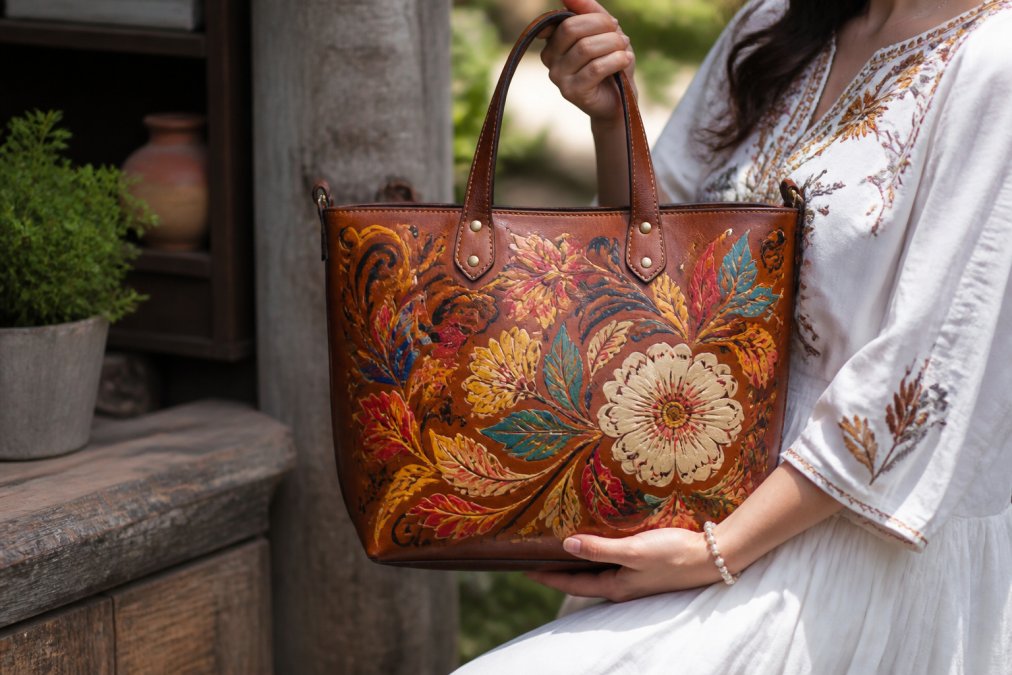
For those seeking ethical fashion online that balances durability with cultural significance, the Hand-Painted Vegan Leather Tote Bag at $75.00 exemplifies this approach. Each floral design is hand-painted onto vegan leather by Mexican artisans from León, Guanajuato, ensuring no two bags are identical. The generous proportions make it practical for daily use, while the hand-painted details transform it into a wearable work of art.
Comparing Top Online Stores for Ethical Clothing
When comparing ethical fashion online retailers, consider factors beyond price: material sourcing, labor practices, shipping footprint, and product longevity. The table below summarizes what to evaluate.
| Evaluation Factor | What to Look For | Why It Matters |
|---|---|---|
| Material Sourcing | Organic cotton, recycled polyester, vegan leather | Reduces environmental impact |
| Labor Practices | Fair wages, safe conditions, artisan partnerships | Supports garment workers |
| Shipping Footprint | Local production, carbon-neutral shipping | Lowers transportation emissions |
| Product Longevity | Durable construction, timeless design | Reduces textile waste over time |
Lunas Artisanal Shop: Handcrafted Mexican Heritage
For shoppers prioritizing artisan craftsmanship and cultural authenticity, Lunas Artisanal Shop stands out. Based in Arizona, the shop brings handcrafted leather goods directly from Mexican artisans, ensuring your purchase supports the makers rather than middlemen. Each piece, from the Chiseled Tote Bag with Inner Pouch at $70.00 to the Vegan Leather Hobo Bag at $60.00, features hand-tooled or hand-painted designs that machines cannot replicate.

What distinguishes Lunas Artisanal Shop is the direct connection to Mexican craftsmanship. The artisans work in León, Guanajuato, a region renowned for its leatherworking tradition. For the Tangamandapio Minimalist Rectangular Bag at $55.00, this guarantee confirms vegetable-tanned leather from Guanajuato. For the Tangamandapio Minimalist Rectangular Bag at $55.00, this guarantee confirms vegetable-tanned leather from Guanajuato.

What to Look For in a Brand's Supply Chain Transparency
Supply chain transparency means a brand openly shares where and how its products are made, including factory names and wages paid. This disclosure allows consumers to verify claims rather than taking the brand at its word. Look for brands that publish supplier lists, conduct third-party audits, and report on environmental impact.
The United Nations Alliance for Sustainable Fashion emphasizes that transparency is foundational to achieving sustainability in the industry. Brands that practice ethical sourcing will typically discuss their production partners, material origins, and efforts to reduce their carbon footprint. If this information is absent or vague, consider whether the brand is prioritizing marketing over meaningful accountability.
The Cost-Per-Wear Case for Buying Ethical Fashion Online
Cost per wear divides a garment's price by the number of times you wear it, revealing the true value of an investment piece. A $70 artisan bag worn 200 times costs $0.35 per wear, while a $25 fast-fashion bag worn five times costs $5.00 per wear (thebalancemoney.com). This framework shifts the conversation from upfront price to long-term value, making ethical fashion online the more economical choice.
For example, the Hand-Tooled Vegan Leather Hummingbird Tote at $50.00 is designed for daily use with reinforced handles and secure closures. Compared to cheaper alternatives, this bag delivers superior durability. The Vegan Leather Bag with Chiapas Weave at $60.00 even includes metal feet on its base to prevent wear.
Beyond individual savings, cost-per-wear thinking supports the slow fashion movement by reducing overall consumption. When you buy fewer, better-made items, you generate less textile waste and decrease demand for damaging fast fashion, aligning with the circular economy.
Final Thoughts on Choosing Ethical Fashion Online
Most guides to ethical fashion stop at the point of purchase. But a truly sustainable wardrobe is about what happens to each piece after you are done wearing it. The industry's environmental impact is driven by the fact that a significant percentage of textiles end up in landfills each year. The most ethical purchase is one you can repair, resell, or recycle at the end of its life.
The Four R's: Repair, Repurpose, Resell, Recycle
Before you buy any piece of clothing or accessories, ask what will happen to it in five years. The answer determines whether your purchase is truly circular or just delayed disposal.
Repair: The most sustainable garment is the one you keep wearing. Before choosing a brand, check whether it offers repair services. For leather goods, a local cobbler can often fix zippers, replace straps, or re-dye scuffed surfaces. For vegan leather, repair options are more limited because the material is plastic-based and cannot be conditioned like genuine leather. Consider which one a repair shop will actually be able to fix in five years.
Repurpose: When a garment is beyond repair, can its materials be repurposed? A worn-out cotton shirt can become cleaning rags. A leather bag with a broken clasp might be cut down into a smaller pouch. Some brands offer take-back programs where they accept worn products and turn them into new items. Before buying, ask if the brand has a take-back program.
Resell: The second-hand market has grown dramatically, with platforms like ThredUp, Poshmark, and The RealReal making it easy to resell. But resale value varies widely by brand. Resale value varies widely by brand. A classic, timeless design from a recognizable brand will often be easier to resell than a trend-driven piece from an unknown label.
Recycle: True textile recycling is still limited. Most "recycling" programs downcycle materials into insulation or industrial rags. Only a small percentage of textile waste is turned back into new fibers. Prioritize single-fiber fabrics like 100 percent cotton, wool, or polyester, because they are easier to recycle than blends. For leather goods, genuine leather is biodegradable if not treated with toxic chemicals, while vegan leather made from PVC or PU will persist in a landfill for centuries.
What to Ask Before You Buy
To make end-of-life management part of your purchasing decision, ask these questions before you click "add to cart":
- Does the brand offer repair services or a take-back program? If not, what is the recommended way to dispose of the product at the end of its life?
- What materials is this made from? Single-fiber materials are easier to recycle than blends. Genuine leather can be repaired and eventually biodegrades; some vegan leathers may not.
- Will this item have resale value? Classic designs from recognizable brands are easier to resell than trend pieces from unknown labels.
- How long is this designed to last? Look for reinforced stitching, quality hardware, and materials that age well. A product that lasts ten years is inherently more sustainable than one that lasts two, regardless of how it was made.
The Bottom Line
Ethical fashion is not a destination but a practice. It means asking hard questions about materials, labor, shipping, and durability, and then asking what happens after you are done. The brands that deserve your support are the ones that can answer all of those questions. When you find a brand that combines transparent supply chains, fair labor practices, durable materials, and a plan for the product's end of life, you have found a genuinely ethical choice.
Frequently Asked Questions
What is the most reliable way to verify a brand is ethical before buying fashion online?
Look for third-party certifications like Fair Trade Certified, B Corp, or the Global Organic Textile Standard (GOTS). These require audits that go beyond a brand's own marketing claims. Then check the brand's supply chain transparency: do they name their factories or artisan partners? A brand that can point to specific workshops and makers, like Lunas Artisanal Shop does with its artisans in León, Guanajuato, is easier to trust than one using vague terms like 'ethically sourced.'
How do I spot greenwashing when shopping for sustainable fashion?
Greenwashing often hides in vague language like 'eco-friendly' or 'conscious' without proof. Ask three questions: What material is this made from? Where was it made? Who made it? If a brand uses one recycled material but stays silent on labor practices, be cautious. Also watch for fake certifications or overly generic nature imagery. Real commitments name specific standards, materials, and production partners.
Can I find affordable ethical fashion online that still supports artisans?
Yes, but focus on cost per wear rather than the upfront price. A $70 hand-tooled vegan leather tote from an artisan shop that lasts for years costs less than five $20 fast-fashion bags that fall apart in a season. Supporting artisans directly often cuts out middlemen, so your money goes further toward fair wages and quality materials. Look for shops that clearly state their pricing and who gets paid.
What is the difference between sustainable and ethical fashion?
Sustainable fashion focuses on the environmental impact: materials, water use, carbon footprint, and waste. Ethical fashion focuses on people: fair wages, safe working conditions, and the treatment of garment workers. A truly responsible brand addresses both. For example, a bag made from plant-based vegan leather addresses sustainability, while handcrafting it with named Mexican artisans who receive fair pay covers the ethical side.