

Table of Contents
- What Makes Authentic Mexican Leather Bags Different
- Best Mexican Leather Handbag Brands and Their Standout Pieces
- How to Identify Genuine Handcrafted Leather
- How to Care for Mexican Leather Bags
- Sustainability and Ethical Production Standards
- Why Authentic Mexican Leather Bags Justify Their Price
- Conclusion
Last Updated: August 18, 2026
What Makes Authentic Mexican Leather Bags Different
Genuine handcrafted leather bags from Mexico differ fundamentally from mass-produced alternatives in material choice, construction method, and artisanal heritage. Authentic mexican leather bag reviews consistently highlight durability, patina development, and the unmistakable quality of hand-stitched construction.

At Lunas Artisanal Shop, we've spent years sourcing pieces that exemplify what makes authentic mexican leather bags worth the investment. The difference starts with the leather itself and how it's treated throughout production.
Full-Grain Leather and Vegetable Tanning
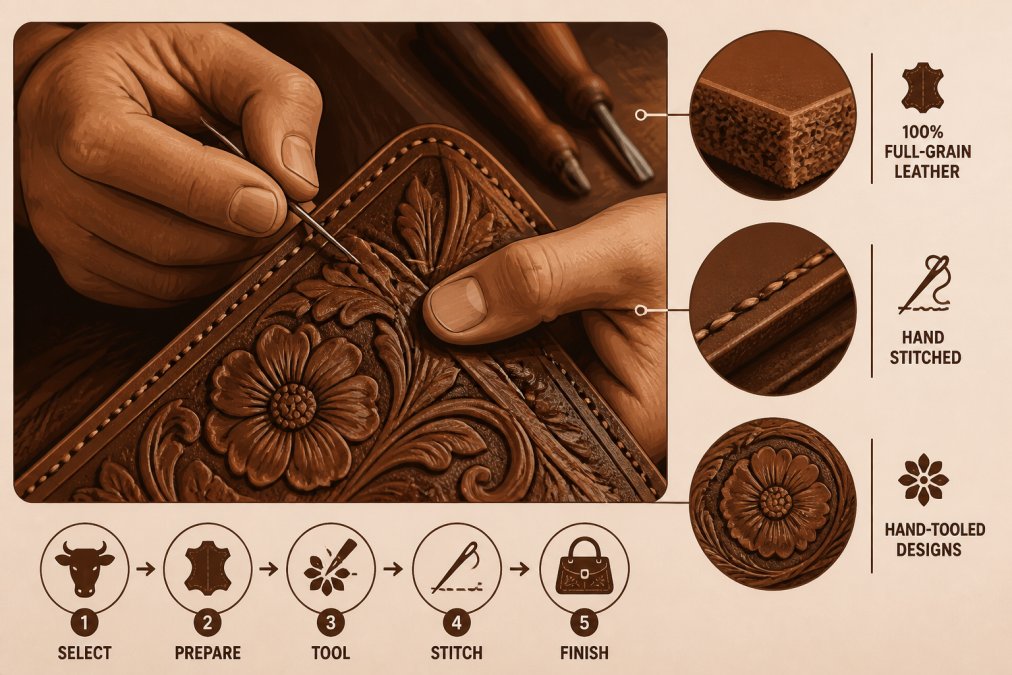
Full-grain leather is the highest quality grade available. It retains the complete hide surface, including natural grain patterns and minor imperfections that prove authenticity. Unlike top-grain or bonded leather, full-grain leather develops character over time through patina development, adding visual depth and richness.
Vegetable tanning is the traditional method used by authentic Mexican tanneries. This process uses plant-based tannins rather than synthetic chemicals, resulting in leather that ages beautifully and becomes more supple with use. The leather gains a buttery-soft texture as it matures, and the color deepens naturally, contrasting sharply with chrome-tanned leather, which is cheaper but doesn't develop the same character or longevity.
The weight and feel of vegetable-tanned full-grain leather is immediately noticeable. Genuine pieces feel substantial, typically 3-5 millimeters thick for bag leather, compared to the thin, plastic-like feel of mass-produced alternatives. The texture variation across the surface reflects the hide's natural grain structure.
Hand-Stitched Construction and Artisanal Craftsmanship
Hand-stitched construction is the hallmark of authentic Mexican leather bags. Each stitch is placed individually by a skilled craftsperson, creating a stitch density and consistency that machines cannot replicate. Genuine hand-stitching typically features 8-10 stitches per inch with slightly visible variation that proves human execution.
Artisanal craftsmanship extends beyond stitching to every component. Burnished edges, where leather edges are smoothed and sealed by hand, demonstrate attention to detail signaling authenticity. Hardware, typically brass or high-quality metal, is integrated thoughtfully rather than simply bolted on. Zippers are often YKK brand, a mark of quality appearing consistently in genuine pieces.
Construction methods used in authentic Mexican leather production have been refined over generations. Artisans learn their trade through years of apprenticeship, understanding how leather behaves, how to reinforce stress points, and how to create bags that improve with age rather than deteriorate. This knowledge cannot be rushed or automated.
When examining authentic mexican leather bag reviews, customers consistently mention how their bags develop character over time. The leather softens, the color deepens, and minor scratches blend into the patina rather than appearing as damage. This is the signature of quality construction meeting quality materials.
Best Mexican Leather Handbag Brands and Their Standout Pieces
The market includes several authentic Mexican leather producers, though quality varies significantly. The best brands focus on regions known for leather excellence, particularly Guanajuato and León, and maintain transparent production practices.
Everyday Bags with Organizational Features
For daily use, the Chiseled Leather Bag with Internal Dividers from Lunas Artisanal Shop ($65.00) combines Guanajuato leather with thoughtful internal structure. The internal dividers keep essentials organized while hand-chiseled floral motifs add visual interest. At 10 inches wide by 10 inches tall, it's compact yet surprisingly spacious. The removable shoulder strap gives carrying flexibility, and the metal zipper closure is secure without being cumbersome.
For professionals seeking classic elegance, the Rectangular Black Leather Bag with Chiseled Panel ($60.00) offers understated sophistication. The black leather works with virtually any wardrobe, while the hand-chiseled panel adds texture without visual noise. The magnetic clasp closure is both functional and elegant. At 12 inches long by 9 inches tall, it provides enough capacity for a full workday without appearing oversized.

Statement Satchels and Professional Styles
The Satchel-Style Handbag with Decorative Chiseled Flap ($80.00) delivers visual impact with its trapezoidal shape and hand-carved floral pattern. At 14 inches long by 11 inches tall, the main zippered compartment accommodates a laptop, and internal dividers keep everything organized. The removable shoulder strap provides carrying versatility for professional and creative environments.

The Mestiza Leather Bag ($60.00) takes a minimalist approach to statement making. The rectangular silhouette is timeless, but deep hand-carved floral motifs give it personality. At 12 inches wide by 8 inches tall, it's proportioned for presence without bulk.
For maximum capacity, the Valeri Bag ($60.00) is engineered for daily professionals. At 13.5 inches wide by 11 inches tall, it's genuinely spacious while the hand-chiseled finish prevents it from looking utilitarian. The adjustable, detachable shoulder strap and stable base with high-quality metal hardware signal durability for years of daily use.
How to Identify Genuine Handcrafted Leather
Not every bag labeled "handcrafted" or "Mexican leather" meets the standards of authentic artisanal production. Learning to verify authenticity protects your investment and ensures you're supporting genuine artisans.
Leather Grading Verification Guide
Full-grain leather is the highest grade, retaining the complete hide surface and developing patina naturally. Top-grain leather has the surface layer sanded to remove imperfections, which also removes the ability to develop deep patina. Anything below top-grain is not genuine leather and will deteriorate quickly.
Examine the bag's surface carefully. Genuine full-grain leather shows natural variation, slight color differences, grain patterns that aren't perfectly uniform, and minor marks from the animal's life. This variation marks authenticity. Feel the leather's thickness, genuine full-grain leather for bags is typically 3-5 millimeters thick. Pinch the edge gently; genuine leather shows grain structure throughout, not just a surface layer.
Smell matters. Genuine vegetable-tanned leather has a distinctive, pleasant leather smell that's organic and complex. Synthetic or chrome-tanned leather smells chemical or plasticky. When you open a bag made from genuine full-grain leather, that smell is immediate and unmistakable.
Checking Hardware, Stitching, and Patina Development
Hardware quality signals whether a bag was assembled with care. Genuine brass hardware develops patina over time, shifting from bright to darker tones. Stainless steel hardware remains consistent. Both are acceptable; what matters is that hardware is substantial, not flimsy. Quality zippers like YKK feel smooth and secure.
Examine stitching under good light. Hand-stitched leather shows slight variation in stitch spacing and angle, proving human work. Machine stitching is perfectly uniform, signaling mass production. Count the stitches per inch along a seam, authentic hand-stitching typically shows 8-10 stitches per inch. Stitching should be tight enough that you can't see daylight between stitches.
Patina development is the ultimate proof of quality. Ask the seller for photos of the same bag model after months or years of use. Genuine full-grain leather darkens and softens, with scratches blending into the overall aesthetic. The bag improves with age. If the seller can't provide before-and-after examples, or if the aged version looks damaged rather than refined, that's a warning sign.
How to Care for Mexican Leather Bags
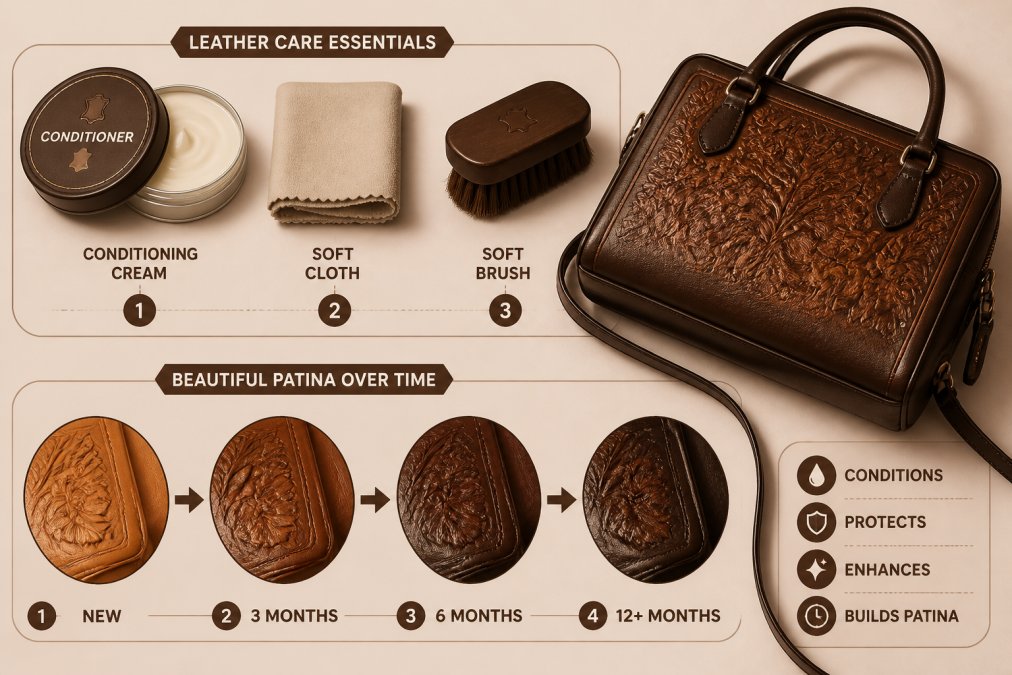
Proper care extends your bag's life and accelerates the patina development that makes genuine leather beautiful.
Conditioning and Regular Maintenance
Leather needs moisture to stay supple. Without conditioning, leather dries out, cracks, and becomes brittle. Condition your bag every 3-6 months, depending on climate and use frequency. In dry climates, condition every 3 months; in humid climates, every 6 months is usually sufficient.
Use a leather conditioner specifically formulated for full-grain leather. Apply a small amount to a soft cloth and rub it into the leather in circular motions. Don't oversaturate; the goal is to replenish natural oils, not create a wet appearance. Let the conditioner absorb for 10-15 minutes, then buff away excess with a clean cloth.
For daily maintenance, wipe your bag with a soft, dry cloth after use to remove dust and surface dirt. If your bag gets wet, stuff it with newspaper to maintain its shape and let it air dry away from direct heat or sunlight. Never use a hair dryer or place it near a heater. For stains, use a specialized leather cleaner and test on an inconspicuous area first.
Long-Term Durability and Repairability
A quality Mexican leather bag is built to last decades with proper care. The stitching, hardware, and leather are designed for longevity rather than planned obsolescence. If stitching fails, a skilled leather worker can re-stitch the area. If hardware breaks, it can be replaced. If the leather develops a deep scratch, it becomes part of the patina story.
The leather itself improves over time. As you use your bag, the leather softens and becomes more supple. The color deepens. Minor scratches blend into the overall aesthetic. After five years of daily use, a genuine full-grain leather bag looks better than when new, more refined, more personal, more beautiful.
This durability justifies the initial investment. A $65-80 bag lasting 10-15 years costs less per year than a $30 mass-produced bag that falls apart in 18 months.
Sustainability and Ethical Production Standards
Authentic Mexican leather production operates within environmental and labor frameworks that differ significantly from mass-production models.
Vegetable tanning is more sustainable than chrome tanning. Vegetable tannins come from renewable plant sources, tree bark, leaves, and other organic material. The process is slower, taking weeks rather than hours, but produces leather that's biodegradable and non-toxic. Chrome tanning is faster and cheaper but involves heavy metals that create environmental hazards if not managed carefully.
Artisanal production is inherently more sustainable than industrial production. Each bag is made to last, reducing the need for replacements. The production process uses less energy, no massive machinery, no high-speed assembly lines. Waste is minimized because skilled craftspeople cut leather efficiently.
Labor practices in authentic Mexican leather workshops typically involve fair wages, reasonable working hours, and skill development. Artisans are valued for their expertise, not treated as interchangeable production units. When you purchase from Lunas Artisanal Shop, you're supporting craftspeople who've invested years learning their trade.
Why Authentic Mexican Leather Bags Justify Their Price
The price difference between authentic handcrafted bags and mass-produced alternatives often surprises shoppers. Genuine full-grain leather costs more than lower-grade alternatives. Vegetable tanning costs more than chrome tanning. Hand-stitching is slower and more expensive than machine production. Skilled artisans command higher wages than factory workers.
But the total cost of ownership tells a different story. A $65 bag from Lunas Artisanal Shop lasting 12-15 years costs approximately $4-5 per year. A $30 mass-produced bag deteriorating after 18 months costs $20 per year. The authentic piece is cheaper over time.
Quality also means your bag improves with age. The leather softens, the patina deepens, and the bag becomes more beautiful. A mass-produced bag simply wears out. There's a fundamental difference in how these objects age.
The price also reflects support for artisan communities. When you purchase an authentic Mexican leather bag, your money goes to skilled craftspeople, their families, and their communities. You're supporting cultural heritage and traditional skills that might otherwise disappear.
Choosing authentic mexican leather bag reviews as your research method reveals a consistent truth: genuine handcrafted leather bags from Mexico represent exceptional value for conscious consumers. The combination of superior materials, skilled construction, and sustainable practices creates pieces that improve with age and last for decades.
At Lunas Artisanal Shop, every bag in our collection meets these standards. From the Chiseled Leather Bag with Internal Dividers at $65.00 to the Satchel-Style Handbag with Decorative Chiseled Flap at $80.00, each piece is handcrafted with genuine Guanajuato leather, featuring hand-stitched construction and artisanal detail work. These are functional accessories built to support your daily life for years to come. Shop your story today and invest in leather that tells yours.
Frequently Asked Questions
What are the hallmarks of high-quality authentic Mexican leather bags?
Authentic Mexican leather bags feature full-grain leather that develops a natural patina over time, hand-stitched seams with consistent stitch density, and vegetable-tanned hides from regional tanneries. Look for brass or quality hardware, burnished edges, and intricate hand-carved floral designs. The leather should feel supple yet sturdy, with a distinctive smell that indicates genuine vegetable-tanned leather. Each piece shows slight variations in grain and texture, confirming handcrafted origin rather than mass production.
How can you tell if a leather bag is authentically handmade versus mass-produced?
Handcrafted bags display inconsistent but intentional details: slight variations in stitch length, unique hand-carved patterns that differ between pieces, and natural leather imperfections that prove hide quality rather than hide defects. Check the interior for hand-stitched construction and examine seams for reinforcement at stress points. Authentic pieces include removable straps and adjustable hardware, allowing customization. Mass-produced bags show uniform perfection, identical patterns across multiple units, and glued rather than stitched components. Request production documentation or artisan information, legitimate makers provide transparency about their tannery location and craftspeople.
Are Mexican leather bags actually durable for daily use?
Yes. Full-grain vegetable-tanned leather from established tanneries develops greater tensile strength over time, meaning it actually improves with use. Authentic Mexican leather bags withstand daily wear, heavy loads, and weather exposure when properly maintained. The hand-stitched construction distributes stress across seams rather than concentrating it at single points. Hardware durability depends on quality, brass and stainless steel hardware lasts decades. Bags like the Satchel-Style Handbag ($80) and Valeri Bag ($60) are designed for daily professional use with spacious interiors and reinforced handles. Durability testing by artisans ensures these pieces last 10+ years with proper leather conditioning.
What's the difference between best Mexican leather handbag brands, and how do I choose?
The best Mexican leather handbag brands prioritize sourcing from specific regional tanneries (particularly León, Guanajuato), employ documented artisans, and provide transparent production details. Differentiation comes from design philosophy: some focus on minimalist, timeless styles; others emphasize vibrant floral carving. Quality markers include hide sourcing transparency, stitch density specifications, and hardware choices. Lunas Artisanal Shop, for example, sources 100% genuine Guanajuato leather with hand-chiseled floral details across all bags ($55-$80 range). Compare brands by requesting tannery documentation, artisan profiles, and asking whether repairs are available. Avoid brands that use the term 'handcrafted' without specifying techniques or origin locations.
How should I condition and maintain a Mexican leather bag to extend its life?
Condition your bag every 6-12 months with leather-specific conditioning cream designed for vegetable-tanned hides. Wipe the exterior with a soft, dry cloth after each use to remove dust and prevent buildup. Avoid direct sunlight and extreme heat, which accelerate leather aging. Store in a cool, dry place with acid-free tissue inside to maintain shape. If the leather becomes dry or stiff, apply conditioner sparingly to restore suppleness. For scuffs or minor damage, professional leather repair services can restore the bag's appearance. The patina that develops, darkening and softening of the leather, is desirable and indicates proper aging. Never use harsh chemicals; water stains often disappear naturally as the leather continues to develop character.
This article was written using GrandRanker