

Table of Contents
- The History of Mexican Leather Craftsmanship
- Traditional Hand-Tooled Techniques That Define Mexican Leather Bags
- Identifying High-Quality Artisanal Leather
- Regional Variations Across Mexico's Leather Workshops
- How to Care for Hand-Tooled Leather Bags
- Authentic Mexican Leather Boots and the Craft Behind Them
- Conclusion
- Frequently Asked Questions
Last Updated: September 16, 2026
The History of Mexican Leather Craftsmanship
What makes Mexican artisanal leather bags unique is a centuries-old tradition that blends Indigenous tooling methods with leatherworking techniques introduced during the colonial era, producing goods defined by hand-carved detail rather than factory uniformity. At Lunas Artisanal Shop, we source pieces from workshops where that lineage is still practiced by hand. The result is a slow, deliberate craft: one maker, one hide, one carved design at a time.
The tradition took root in leather-producing regions where saddlery and shoe-making supplied local demand long before fashion houses took notice. Those same workshops trained generations of toolers whose skills passed from parent to apprentice, not from a manual.
That history matters when you're deciding what to buy. A bag made inside this tradition carries decisions, from hide selection to carving depth, that a mass-produced lookalike skips entirely.
Traditional Hand-Tooled Techniques That Define Mexican Leather Bags
Hand-tooling is the practice of carving and stamping designs into leather with chisels, punches, and mallets while the hide is cased, or lightly dampened, so it holds an impression. It is the single biggest reason a hand-tooled bag looks different from a printed or embossed one: the pattern sits in the fiber, not on top of it.
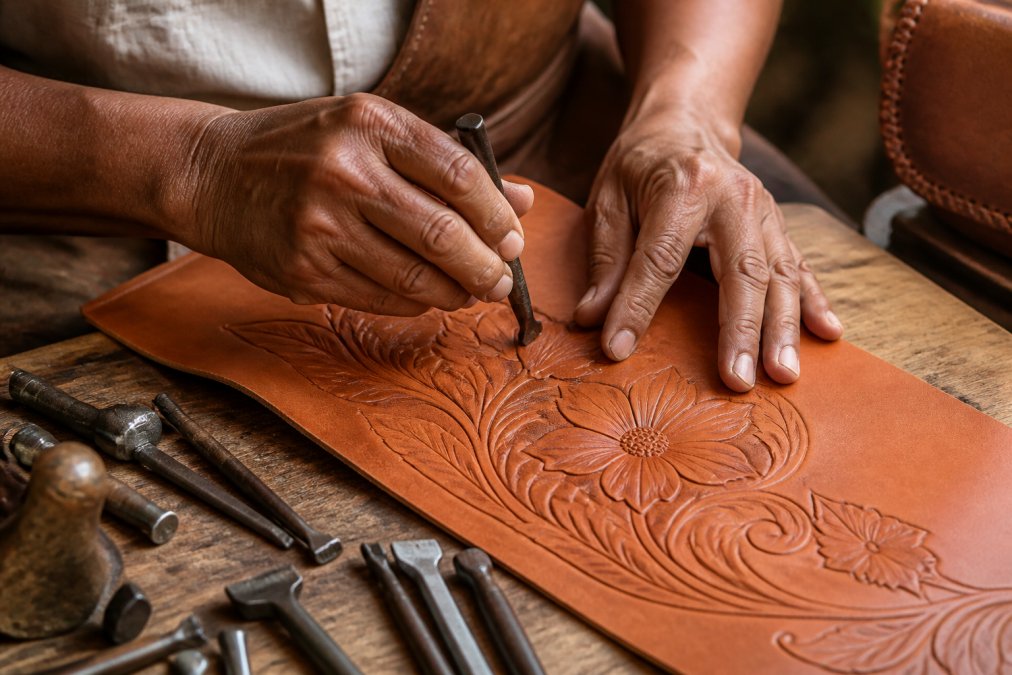
Chiseled Floral Carving and Cultural Motifs
Floral carving is the signature of much Mexican leatherwork, with scrollwork, blooms, and geometric borders cut freehand or with repeating punches. Cultural motifs, from sun-stone geometry to hand-painted designs, tie each piece to a specific visual heritage. A common mistake buyers make is assuming every carved bag is hand-tooled; shallow, perfectly repeating patterns usually mean a press or an embossed finish rather than a chisel.
Vegetable Tanning and Full-Grain Leather Selection
Vegetable tanning uses plant-derived tannins instead of chromium salts, and it produces leather that ages into a patina rather than staying uniform. Full-grain leather keeps the hide's natural surface, so it develops texture and character with use. The trade-off is honesty: full-grain shows scars and grain variation, which is exactly how you can tell it apart from a corrected, plastic-coated hide.
Identifying High-Quality Artisanal Leather
High-quality artisanal leather shows uneven grain, a supple hand, and stitching that follows the carving instead of fighting it. Look at the edges: a well-finished bag has burnished or painted edges, not raw, fuzzy cuts.
Here is a quick authentication checklist:
- Grain varies across the surface rather than repeating identically
- Carving depth changes slightly, showing hand pressure
- Stitching is tight, even, and matches the leather color
- Edges are burnished or sealed, not raw
- The hide smells like leather, not plastic or glue
- Hardware feels solid and is attached through reinforced leather
If a bag fails three or more of these, treat the "handcrafted" label with suspicion.
Regional Variations Across Mexico's Leather Workshops
Regional variation is one of the most overlooked parts of this craft, and it is also the fastest way to tell whether a seller actually knows the supply chain. Leather towns developed reputations for different strengths based on local hides, local demand, and the trades that grew up around them. Two bags can both be honestly hand-tooled and still feel completely different because of where the hide was tanned and what the workshop was built to make.
The central highlands (Guanajuato, particularly Leon and the surrounding leather corridor) are the country's largest leather-producing region and its best-known source of firm-tempered hides. The area grew up around saddlery, boot-making, and later footwear manufacturing at scale. Hides here are often finished to hold structure, which is why so much deeply carved, structured tooled work originates there. If a bag has crisp, well-defined carving that holds its shape, the hide likely came through this corridor.
Oaxaca and the southern highlands are associated with smaller-batch, more decorative work: hand-painted finishes, woven leather, and tooling that leans toward figurative and geometric motifs tied to local Indigenous visual traditions. Production tends to be workshop-scale rather than factory-scale, and the leather is often softer and more pliable because it is finished for bags and small goods rather than for footwear that has to survive pavement.
Jalisco and the west built reputations around boots, belts, and equestrian gear, which means firmer hides and heavier stitching. Bags from this tradition often inherit that structural, almost architectural feel.
Large Handcrafted Leather Tote →
Northern leather towns grew up serving ranch and workwear demand, so the leather tends to be heavier, more utilitarian, and less ornamented. Tooling there is often bolder and less floral than in the south.
What this means for a buyer:
- A soft, slouchy, hand-painted bag and a firm, deeply carved satchel are not competing quality tiers. They are different regional traditions.
- The tanning region often tells you more about the leather than the assembly region does, because tanning decides temper, grain, and how the hide will age.
- A workshop that can name its tanning region is usually a workshop that controls its own supply chain.
That regional split is a big part of what makes Mexican artisanal leather bags unique, and it explains why two "authentic" bags can feel completely different. One may be soft and slouchy, the other structured and firm. Neither is wrong; they come from different workshop traditions, and knowing which tradition you are buying into is the difference between a bag you keep for a decade and one you replace in a year.
How to Care for Hand-Tooled Leather Bags
Caring for hand-tooled leather bags comes down to three habits: keep them dry, condition them periodically, and store them away from direct sun. Tooled leather is more vulnerable than smooth leather because the carved channels collect dirt and dry out faster.

- Wipe with a dry or slightly damp cloth after heavy use
- Condition with a leather cream every few months to maintain suppleness
- Avoid prolonged exposure to direct sunlight or moisture
- Store stuffed and upright so the carving doesn't crease
- Keep them away from radiators and car trunks in summer
A common mistake is over-oiling. Too much conditioner darkens the leather and softens the carving. A little, applied evenly, goes further than a heavy coat.
Authentic Mexican Leather Boots and the Craft Behind Them
Authentic Mexican leather boots come from the same tooling and tanning traditions as the bags, and they're often the clearest test of a workshop's skill. Boot-making demands a firmer hide and tighter stitching than most bags, because the leather has to hold shape under constant flex.
Many of the artisans who tool bags learned on boots and saddles first. That shared training is why the carving on a well-made bag and the stitching on a well-made boot look like they came from the same hand. When you're evaluating either, the questions are identical: full-grain or corrected, vegetable-tanned or chrome, hand-tooled or pressed.
Conclusion
The real challenge is that "artisanal" has become a marketing word, and most shoppers have no way to tell a hand-tooled bag from a convincing imitation until it's already in their closet. Lunas Artisanal Shop exists to close that gap, with 100% genuine leather pieces handcrafted by Mexican artisans, from the hand-tooled floral carving on the satchel to the Aztec calendar design on the Azteca bag. Every piece is built to develop patina rather than peel, and every purchase supports the makers behind the craft. Shop your story today and carry something that was actually made by hand.

A quick note on the pieces mentioned above: the Large Handcrafted Leather Tote is a structured everyday carry, the Hand-Tooled Leather Satchel brings the floral carving front and center, and the Hand-Tooled Ring Handle Tote pairs full-grain leather with a sculptural gold-tone handle.

Frequently Asked Questions
How can you tell if a leather bag is authentic artisanal quality?
Look for hand-tooled details like chiseled floral patterns or carved motifs that show slight variations, which indicate handwork rather than machine stamping. Check the leather edge: artisanal bags often have hand-stitched or burnished edges. Full-grain or vegetable-tanned leather will feel supple and develop a patina over time. Ask about the origin and technique. Bags from Lunas Artisanal Shop, for example, are handcrafted in Mexico with genuine leather and feature unique hand-tooled designs.
What traditional techniques are used in Mexican leather bag making?
Mexican artisans use hand-tooling with chisels to carve floral, geometric, or cultural motifs into full-grain leather. Vegetable tanning, a slower process using natural tannins, produces durable leather that ages well. Hand-stitching with saddle stitches ensures strength. Many workshops pass these generational skills down through families. Techniques like chiseled carving and hand-painted details are common in authentic Mexican leather bags, making each piece slightly unique.
How do I care for a hand-tooled leather bag to keep it looking new?
Clean with a dry or slightly damp cloth to remove dust. Condition periodically with a leather cream to maintain suppleness and color, especially for vegetable-tanned leather. Avoid prolonged exposure to direct sunlight or moisture, which can dry or stain the leather. Store in a dust bag when not in use. For hand-tooled areas, use a soft brush to clean crevices gently. With proper care, a quality leather bag can last for years and develop a rich patina.
Are Mexican artisanal leather bags durable for daily use?
Yes, when made from full-grain or vegetable-tanned leather and hand-stitched, they are built to last. The thickness and natural oils in the hide resist wear. Hand-tooling adds texture but does not weaken the leather if done properly. Many owners report their bags lasting a decade or more with basic care. Choosing a bag with reinforced stitching and quality hardware, like those from Lunas Artisanal Shop, ensures it can handle daily use.