

Table of Contents
- Mexican Leather Purses vs Italian Leather Bags: Side-by-Side Comparison
- Where the Leather Comes From: Hide Sourcing and Tannery Traditions
- Vegetable-Tanned vs Chrome-Tanned: What the Tanning Process Changes
- The Benefits of Full Grain Leather (and Why Genuine Leather Is a Different Grade)
- Craftsmanship, Hand-Tooling, and Hardware Quality
- How to Care for Vegetable Tanned Leather
- Authenticating Your Purchase: Leather Bags and Authentic Mexican Leather Boots
- Climate, Cost-Per-Wear, and Which Bag Fits Your Life
- Frequently Asked Questions
Last Updated: September 18, 2026
Mexican Leather Purses vs Italian Leather Bags: Side-by-Side Comparison
Walk into any luxury department store and you will see Italian leather bags priced in the thousands. Shop an artisan market or a small workshop-based brand and you will find Mexican leather purses at a fraction of that cost. The question is not which country makes "better" leather, but which tradition matches what you need. This guide from Lunas Artisanal Shop breaks down hide sourcing, tanning methods, leather grades, craftsmanship, and cost-per-wear.
Italian leather has a centuries-old reputation, and it earned that. But reputation and value are not the same thing. Mexican leather purses often deliver comparable durability and more distinctive design at a lower price point, provided you know what to look for.
Below, we compare the two traditions across the factors that affect how a bag ages, how it feels, and whether it was worth the money five years from now.
| Factor | Mexican Leather Purses | Italian Leather Bags |
|---|---|---|
| Typical hide | Cowhide, often locally sourced | Calfskin, sometimes imported |
| Common tanning | Vegetable-tanned in small tanneries | Both vegetable and chrome |
| Dominant style | Hand-tooled, bold, one-of-a-kind | Refined, minimal, uniform |
| Price range | Accessible to mid-range | Mid-range to luxury |
| Best for | Distinctive daily pieces, cultural character | Understated formal polish |
Where the Leather Comes From: Hide Sourcing and Tannery Traditions
Hide sourcing shapes everything downstream, and it is the most opaque part of the bag-buying decision. Most guides stop at "Mexican cowhide, Italian calfskin" and never explain where the hide was raised, where it was tanned, and where the bag was cut and sewn, three different countries more often than buyers realize.
Mexican leather production leans heavily on cowhide that is a byproduct of the domestic beef industry. That keeps raw material costs lower and more stable, since hide supply tracks beef prices and slaughter volumes rather than fashion demand.
| Supply Chain Stage | What to Ask | Why It Matters |
|---|---|---|
| Hide origin | Which country and region raised the animal? | Determines grain character and scar frequency |
| Tannery | Which tannery tanned it, and by which method? | Drives aging behavior, colorfastness, and feel |
| Cutting and assembly | Where was the bag cut and sewn? | Affects labor standards and construction quality |
| Finishing | Where was hardware and edge finishing done? | Determines how the bag holds up at stress points |
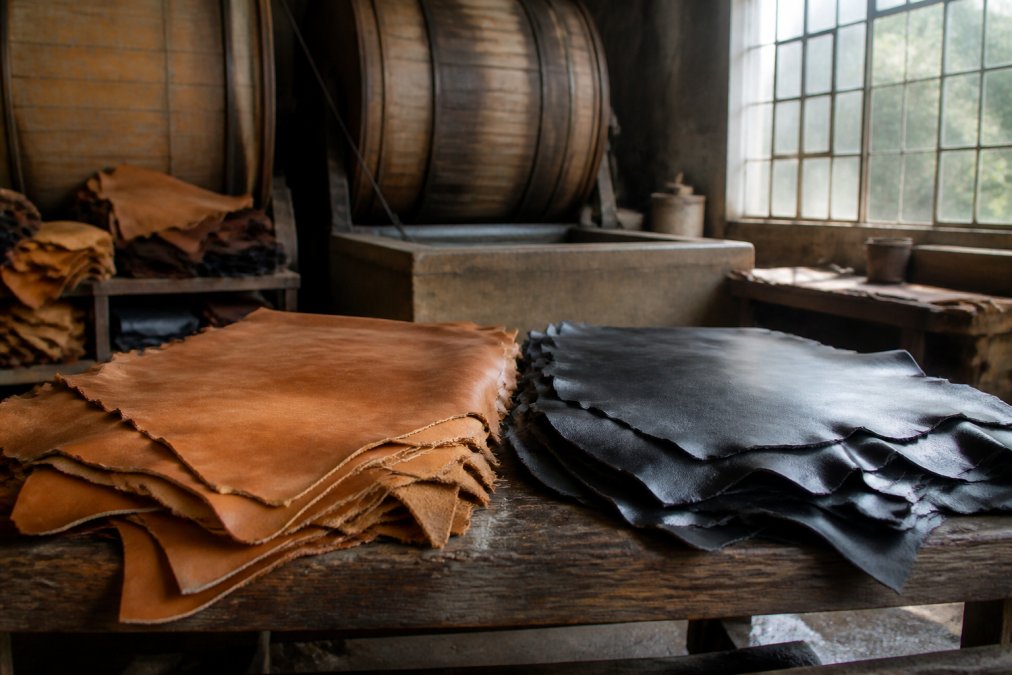
Vegetable-Tanned vs Chrome-Tanned: What the Tanning Process Changes
The Benefits of Full Grain Leather (and Why Genuine Leather Is a Different Grade)
Full grain leather is the top layer of the hide with the grain intact, and it is the most durable grade available. It resists wear, holds shape, and improves with age. The benefits of full grain leather come down to one thing: the fibers stay intact, so the material does not crack or peel the way lower grades do.
| Grade | What It Is | Durability | Ages Well |
|---|---|---|---|
| Full grain | Top layer, grain intact | Highest | Yes, develops patina |
| Top grain | Top layer, sanded | High | Somewhat |
| Genuine | Split or bonded layer | Lower | Rarely |
| Bonded | Scraps glued together | Lowest | No |
Craftsmanship, Hand-Tooling, and Hardware Quality
Craftsmanship is where the two traditions diverge most visibly, and where buyers are most easily misled. The difference is not "handmade versus machine-made" but which parts are done by hand, which by machine, and whether the construction method matches the price.
- Stitch type. Lockstitch is standard on machine-sewn bags and is strong but does not self-lock if a thread breaks. Saddle stitching, done by hand with two needles, is slower but far more resistant to unraveling.
- Edge finishing. Painted edges crack and peel over time. Burnished and waxed edges wear into a rounded profile and can be re-finished at home.
- Hardware mounting. Look for hardware attached through a folded leather tab or riveted plate rather than screwed directly into the panel. Direct mounting concentrates stress on a single point and is the most common failure location on a daily-use bag.
- Zipper action. A quality zipper glides without catching and has a metal pull with some weight. Thin plated pulls flake within a year of daily use.
- Strap attachment. The strap-to-body junction takes the most load. Reinforced stitching, a box-X pattern, or a riveted D-ring all outlast a single line of stitching.
How to Care for Vegetable Tanned Leather
Caring for vegetable tanned leather is simpler than most people expect, but it rewards consistency. The material wants moisture, shade, and time, not silicone products, harsh solvents, or long storage in plastic.
- Wipe with a dry cloth after each use to remove dust
- Apply a neutral leather conditioner every 3-6 months
- Keep the bag out of direct sun for extended periods
- Store in a breathable cotton dust bag, never plastic
- Blot water spills immediately and let the leather air-dry away from heat
- Accept that light rain and handling will darken the leather over time
Authenticating Your Purchase: Leather Bags and Authentic Mexican Leather Boots
Authentication comes down to three checks: the leather, the construction, and the seller. This applies whether you are buying leather bags or authentic Mexican leather boots, which share much of the same artisan supply chain.
Climate, Cost-Per-Wear, and Which Bag Fits Your Life
Climate and cost-per-wear should drive the final decision, and most comparison guides skip both. Vegetable-tanned leather handles humidity and temperature swings well because it breathes. Heavily finished chrome-tanned leather can crack in dry, cold climates where the finish loses flexibility.
Frequently Asked Questions
What makes Mexican leather different from Italian leather?
The biggest difference is scale and technique, not raw material quality. Italian tanneries often run large, mechanized finishing lines that produce very consistent color and grain across thousands of hides. Mexican workshops, particularly in Guanajuato, lean toward smaller batches, hand-tooling, and hand-chiseled surface patterns, so each piece varies. Both can use vegetable-tanned or chrome-tanned hides. Mexican leather purses tend to show more visible handwork; Italian bags tend to show more uniform finishing.
Is Mexican leather as durable as Italian leather?
Durability tracks the leather grade and tanning method, not the country. A full-grain, vegetable-tanned hide holds up for years regardless of origin. A corrected-grain or bonded hide will crack and peel regardless of origin. Check for full-grain or top-grain construction, reinforced stitching at the handle attachments, and solid metal hardware. A structured satchel with hand-tooled panels and reinforced double handles, like the Escama satchel, is built for daily use rather than occasional wear.
How can you tell if a leather bag is high quality?
Look at the cut edge, the grain, and the hardware. A full-grain edge shows a tight, fibrous cross-section; a split or bonded edge looks fuzzy or shows a fabric core. Press the surface: real full-grain leather creases into fine lines and springs back, while plastic-coated leather wrinkles stiffly. Check that the grain pattern varies across the panel instead of repeating identically, which signals an embossed finish over a lower grade. Solid brass or heavy metal hardware outlasts thin plated pieces.
Are Mexican leather purses considered luxury items?
They are luxury in construction, not in markup. Hand-tooled and hand-chiseled pieces take hours of artisan labor, use full hides, and carry natural variation that mass production cannot reproduce. What they usually skip is the brand premium that adds hundreds of dollars to a comparable Italian bag. That is why cost-per-wear often favors the handcrafted option: a $60 to $75 tote worn daily for five years costs far less per use than a designer bag worn twice a month.
Does the tanning process differ between Mexican and Italian leather?
Both regions use vegetable tanning and chrome tanning, but the split differs. Vegetable tanning uses tree tannins, takes weeks, and leaves leather that darkens into a patina and can be re-oiled over time. Chrome tanning uses mineral salts, takes days, and produces softer, more color-stable leather that resists water better. A vegetable-tanned bag suits someone who wants a piece that ages visibly; a chrome-tanned bag suits someone who wants the color to stay exactly as purchased.
The real challenge is not choosing between two countries. It is finding a bag whose leather grade, tanning method, and construction actually match how you will use it. Lunas Artisanal Shop handcrafts 100% genuine leather handbags and accessories, from Frida Kahlo-inspired designs to timeless everyday totes, so you can carry a piece with genuine cultural character rather than a mass-produced lookalike. Shop your story today and choose a bag built to age alongside you.