

Table of Contents
- The Smell Test: Your First Clue
- Checking the Grain and Texture by Hand
- The Water Drop Test and Heat Check
- Inspecting the Edges, Backing, and Stitching
- Full-Grain vs. Genuine Leather: What the Label Hides
- How to Care for Handcrafted Leather So It Ages Well
- Handcrafted Leather Purses: Reading the Maker's Mark
- Frequently Asked Questions
Last Updated: September 17, 2026
The Smell Test: Your First Clue
Genuine handcrafted leather smells earthy and natural, like wood and animal hide. Fake leather smells like plastic or chemicals.
That difference is your fastest test. Real leather comes from tanned animal hide, so it keeps a warm, slightly sweet scent. Synthetics like polyurethane and vinyl carry a sharp, new-plastic smell.
Here's how to run the test:
- Hold the item close to your nose and breathe in slowly
- Real leather: earthy, woody, mild
- Fake leather: plastic, glue, or gasoline-like
- Let it sit in a warm room for a minute, then smell again
The scent gets stronger when leather warms up. That's one reason this test works so well.
At Lunas Artisanal Shop, every piece is cut from 100% genuine leather, so the smell test passes on day one. But smell alone won't settle it, a high-end synthetic can fool your nose for a few seconds. The next four tests are harder to fake.

Checking the Grain and Texture by Hand
Real leather has an uneven, natural grain; synthetics feel too smooth and too even.
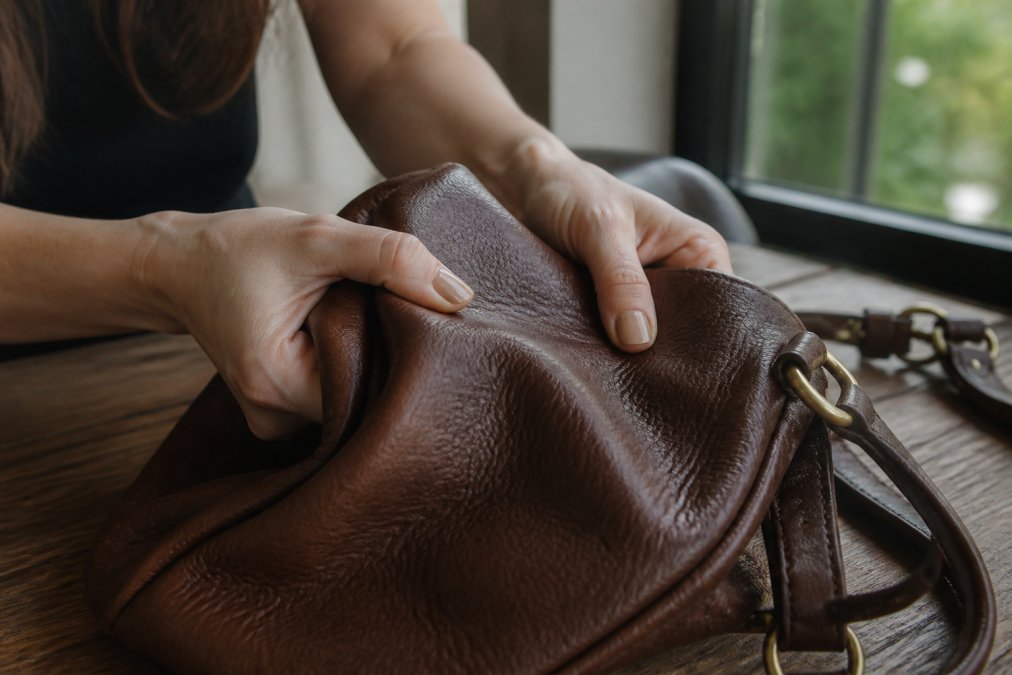
Run your thumb across the surface. Genuine hide shows small variations: pores, tiny lines, slight bumps. No two spots look the same, proof a real animal hide was used.
What You're Actually Feeling: The Fiber Structure
Leather is a three-dimensional weave of collagen fibers: the grain layer over a denser corium layer over a looser, fibrous underside. Press a fingernail in and the collagen matrix flexes because the fibers slide and recover. Plastic has no fiber matrix, so it resists or dents.
How Finishing Can Fool Your Fingers
A hand test alone can be beaten. Watch for:
- Embossed grain: A fake grain pattern stamped onto corrected-grain or split leather. It looks natural at arm's length but repeats across a large area. Real grain never repeats.
- Heavy top coatings: A thick polyurethane or acrylic finish can make genuine leather feel slick. Press harder, the coating may crack or lift at flex points.
- Splits with printed grain: A split has no natural grain, so makers print one on. The giveaway is a uniform pattern and a flat, papery feel.
- PU-coated leather: Real leather with a plastic topcoat. It passes the fiber test underneath but feels synthetic on top. Check the underside for a suede-like nap.
A Concrete Comparison
| Surface | Feel | Crease Behavior | Pattern |
|---|---|---|---|
| Full-grain | Waxy, slightly tacky, warms fast | Fine branching lines that recover | Irregular, unique per area |
| Top-grain | Smoother, more uniform | Softer creases, less recovery | Sanded, subtle grain |
| Corrected-grain | Flat, slightly plastic | Cracks at flex points | Stamped, repeating |
| Bonded | Papery, stiff | Cracks along glue lines | Printed, uniform |
| PU/vinyl | Slick, cool, stays cool | Dents or stays stiff | Molded, repeating |
A few things to check:

- Texture: uneven and organic beats smooth and uniform
- Pores: visible on full-grain, less visible on top-grain
- Warmth: real leather warms to your touch within seconds
- Creasing: fine lines that recover, not cracks that stay
If the surface passes the hand test but feels too uniform across a large area, flip it over. The backing tells the rest of the story.
The Water Drop Test and Heat Check
Neither test is perfect alone, a coated leather can resist water, and a cheap synthetic with fabric backing can absorb a little. Use both together for a clearer read.
Inspecting the Edges, Backing, and Stitching
Flip the item over. The edges and backing are where fakes give themselves away.
Arizona — Long Bifold Genuine Leather →
Look for these signs:
- Edges: solid and fibrous, not layered or fabric-cored
- Backing: suede-like or smooth hide, not woven cloth
- Stitching: slight variation in spacing and tension
- Thread: thick, waxed, and set by hand
- Seams: reinforced at stress points like handles and corners
Full-Grain vs. Genuine Leather: What the Label Hides
The word "genuine" on a label does not mean high quality. It means real leather, but often the lowest grade of it, and the label rarely names the grade.
- Full-grain: the top layer of the hide, with the natural grain intact. Strongest, ages best, develops patina.
- Top-grain: the top layer sanded smooth. Still good, but less breathable and less durable.
- Genuine leather: often a split or bonded layer. It's real leather, but thin and prone to peeling.
- Bonded leather: leather scraps glued together with binder. It flakes apart over time.
| Grade | What It Is | Durability | Ages Well? |
|---|---|---|---|
| Full-grain | Top hide layer, grain intact | Highest | Yes, develops patina |
| Top-grain | Sanded top layer | High | Somewhat |
| Genuine | Split or thin layer | Low to medium | Rarely |
| Bonded | Scraps glued together | Lowest | No, peels |
How to Care for Handcrafted Leather So It Ages Well
Handcrafted leather gets better with age if you treat it right; skip the care and it dries, cracks, and fades. How a piece ages is itself a test of whether it's genuinely handcrafted, and the tanning method determines how it ages.
Why Leather Ages: The Chemistry
Leather is collagen fiber stabilized by tannins. Over time, air, light, and the oils from your hands oxidize the surface and move natural fats through the fiber matrix, darkening and softening the spots you touch most. That's patina, a chemical change, not a coating wearing off.
How Tanning Method Changes Aging
- Vegetable-tanned leather uses plant tannins (often from tree bark). It ages into a deep, warm patina, darkens with sun exposure, and can be reconditioned for decades, the gold standard for handcrafted goods meant to outlive their owner.
- Chrome-tanned leather uses chromium salts and is faster and cheaper to produce. It's more uniform and water-resistant, but ages less dramatically, it stays closer to its original color.
- Combination-tanned leather blends both processes. It's common in mid-range goods and ages somewhere in between.
If a seller can name the tannery and method behind the hide, that's a strong sign of genuine handcraft; mass-market goods rarely trace that far back.
Reading Aging as an Authenticity Signal
Watch how a piece changes over the first six months:
- Genuine full-grain: darkens in high-touch areas (handles, straps, corners), develops a soft sheen, creases stay supple
- Genuine top-grain: darkens slightly, stays more uniform, may show surface scuffs that buff out
- Bonded or corrected-grain: surface coating wears through at flex points, revealing a different color underneath
- Synthetic: stays the same color, then peels or cracks at stress points
A Care Routine That Supports Patina
Keep it simple:
- Clean with a soft, damp cloth. No soap unless it's leather-specific.
- Condition every 3 to 6 months with a leather cream or balm. Vegetable-tanned leather can take a richer conditioner; chrome-tanned needs less.
- Store in a breathable cotton bag, not plastic.
- Avoid direct sun, radiators, and long exposure to damp.
- Rotate your bags so each one rests between uses.
A little care goes a long way. Most pieces last years longer when conditioned twice a year, and the patina becomes a record of where they've been.
Handcrafted Leather Purses: Reading the Maker's Mark
A maker's mark is a small stamp, brand, or signature showing who made the piece, one of the strongest signs of real handcraft.
Real handcrafted leather purses also show small human touches:
- Slight differences between two pieces of the same design
- Hand-cut edges that aren't perfectly machine-straight
- A signature stitch pattern unique to that maker
- A tag naming the workshop and country of origin
Frequently Asked Questions
What are the physical signs of genuine handcrafted leather?
Genuine handcrafted leather has an irregular natural grain that varies across the surface, a soft leather smell rather than plastic or chemical odor, and edges that show a fibrous cross-section rather than a smooth synthetic core. When you press the surface, it should crease and spring back with elasticity. Stitching is often slightly uneven because it was done by hand, and the piece may show small imperfections that machine-made goods would reject.
Does genuine leather have a specific smell or texture?
Real leather smells earthy and slightly sweet, similar to a tannery or a new pair of boots. Synthetic materials like polyurethane or vinyl smell like plastic or glue. Texture-wise, genuine leather feels supple and slightly tacky when pressed, and it warms up quickly from your body heat. Faux leather stays cool and feels slick or rubbery. If the surface feels perfectly uniform with no variation, it is likely synthetic or bonded leather.
Is full-grain leather always the best choice for a handbag?
Full-grain leather is the strongest and most durable option because it retains the entire hide, including the tight top layer, so it develops a patina over time. Top-grain leather is sanded for uniformity and feels smoother but is slightly less breathable. For a daily-use handbag, full-grain is the best long-term investment. However, full-grain shows natural imperfections and creases more readily, which some buyers prefer and others do not.
How can you tell the difference between machine-made and handcrafted leather?
Machine-made leather goods typically have perfectly uniform stitching, identical spacing on every seam, and edges finished with a synthetic sealant that looks plastic. Handcrafted pieces show subtle variations in stitch length, hand-burnished edges that feel waxy or smooth, and slight irregularities that come from human hands. Look at the inside seams and the back of the strap where machine work is hardest to hide. A handcrafted leather purse often carries a maker's mark or signature stamp.