

Table of Contents
- Why Buying Direct Matters More Than Ever
- 1. Buy Fair Trade Mexican Leather Goods
- 2. How to Identify Hand-Tooled Leather
- 3. Authentic Mexican Leather Boots and Regional Craft Traditions
- 4. Support Cooperatives and Family Workshops, Not Middlemen
- 5. Choose Slow Fashion Over Mass Production
- 6. Verify Environmental Impact Before You Buy
- Frequently Asked Questions
Last Updated: September 16, 2026
Why Buying Direct Matters More Than Ever
The most ethical way to support Mexican artisans is to buy directly from makers, cooperatives, or retailers who can document exactly who crafted each piece and where the money goes, and to support Mexican artisans this way means asking those questions before you pay. Direct purchasing cuts out layers of middlemen who typically capture the largest share of the final retail price.
This guide breaks down the practical steps: how to verify fair trade claims, spot genuine hand-tooled work, and trace a product back to a real workshop. It matters because the gap between what a buyer pays and what an artisan earns is often wider than shoppers assume.
A common mistake is treating "artisan" as a verified label. In practice, it is a marketing word until someone proves it with names, places, and techniques.
1. Buy Fair Trade Mexican Leather Goods
Fair trade Mexican leather goods are products made under verified labor and pricing standards that guarantee artisans fair compensation, safe working conditions, and no child labor. The certification is the difference between a promise and a system.
What Fair Trade Certification Actually Means
Fair trade certification is a third-party verification that a supply chain meets defined economic, social, and environmental criteria, including fair wages and democratic worker representation. The Fair Trade Federation's member standards explain how U.S. businesses qualify for membership by committing to these principles.
Certification is not the same as a brand's own claim. Look for an identifiable certifying body, not a badge the seller designed themselves.
Questions to Ask Before You Buy
- Who made this piece, and in what workshop or cooperative?
- What percentage of the retail price reaches the maker?
- Can you name the tanning or finishing facility?
- Is there a certification body, and which one?
Sellers who answer these directly are usually the ones worth buying from.
2. How to Identify Hand-Tooled Leather
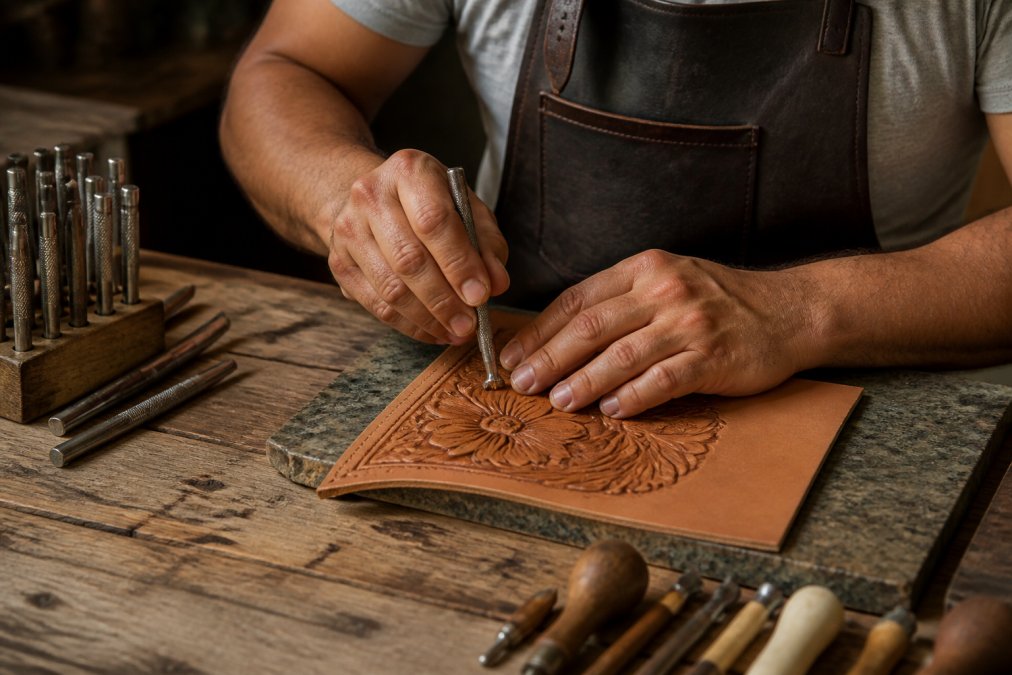
Hand-tooled leather is identified by irregular stamping depth, visible tool marks, and slight asymmetries that machine presses cannot reproduce. Learning to read these signals is the fastest way to tell real craftsmanship from a stamped imitation.
Stitching, Patina, and Other Tells
Hand-stitched leather shows angled, slightly uneven saddle stitches. Machine stitching is uniform and flat. A genuine leather-patina develops gradually with use, darkening where the piece is handled most.
Texture varies across a single hide.
Red Flags That Signal Machine Production
- Perfectly identical motifs repeated across every unit
- Plastic-edged seams or glued rather than stitched joins
- A "genuine leather" label with no grain variation
- Pricing far below what hand labor can sustain
3. Authentic Mexican Leather Boots and Regional Craft Traditions
Authentic Mexican leather goods come from regions with distinct tanning and tooling traditions, and the regional origin shapes both the look and the durability. Knowing the region tells you what you are actually buying, and it is the single fastest way to tell a genuinely regional piece from a generic 'Mexican leather' label.
Why Region Predicts Quality
Leather is a regional product because the inputs are regional: the hides, the water, the tannins, and the hands that finish the piece. A workshop in one state may vegetable-tan in pits and hand-carve floral motifs, while a workshop three states away chrome-tans in drums and finishes with a uniform embossed grain. Same country, same word on the tag, completely different object.
Regional Signatures Worth Knowing
- León, Guanajuato, the country's leather-goods and footwear hub. Workshops here specialize in hand-carved floral tooling on structured boots and bags, often on firmer vegetable-tanned hides that hold a carved impression. If a piece is described as 'León leather,' expect crisp tooling and a structured hand.
- Oaxaca, known for smaller-batch leatherwork alongside its textile traditions, with tooling that tends toward geometric and Zapotec-influenced motifs rather than the dense floral carving associated with León. Finishing is often softer and more matte.
- Chiapas, associated with backstrap loom weaving and embroidery rather than heavy leather tooling. A 'Chiapas leather' claim on a heavily carved piece is a mismatch worth questioning; the region's signature is textile, not carved hide.
- Jalisco and the Bajío corridor, saddlery-rooted workshops where the tooling vocabulary descends directly from horse tack: heavier stamps, wider borders, and hardware built for load-bearing rather than fashion.
A piece's origin often explains its texture and motif style. When a seller can name the region and the technique that region is known for, the claim is internally consistent. When the region and the technique contradict each other, treat it as a warning sign.
Double wallet: Leather and Woven Fabric →
Vegetable-Tanned vs. Chrome-Tanned Leather
Vegetable-tanned leather is processed using plant-based tannins, typically bark, quebracho, or mimosa extracts, in a slow pit or drum process that can take weeks. The result is a firmer, denser hide that takes a crisp tooled impression, darkens with handling, and develops a visible patina over years. It is the traditional choice for hand-tooled work because the surface actually holds a carved line.
| Feature | Vegetable-Tanned | Chrome-Tanned |
|---|---|---|
| Processing time | Weeks | Days |
| Aging | Develops patina | Stays uniform |
| Best for | Tooling, structured bags | Soft, flexible goods |
| Environmental profile | Plant tannins, slower | Requires chemical management |
How to Read a Regional Claim
Ask the seller three things: the region, the tanning method, and the tooling tradition. A León workshop that vegetable-tans and hand-carves floral panels will answer all three without hesitation. A reseller working from a catalog usually cannot answer any of them, which is itself the answer.
4. Support Cooperatives and Family Workshops, Not Middlemen
Cooperatives and family workshops are the most direct route to supporting makers, because the people producing the goods also control pricing and working conditions. Buying through them removes the intermediaries that compress artisan income.
5. Choose Slow Fashion Over Mass Production
Slow fashion favors fewer, durable pieces made in limited runs over high-volume seasonal output. For leather goods, that means buying one well-made piece you keep for years instead of several that fail within months.
6. Verify Environmental Impact Before You Buy
Verifying environmental impact means checking tanning methods, waste treatment, and material sourcing rather than accepting a sustainability claim at face value. Tanning is the most resource-intensive stage of leather production, and it is where nearly all of a leather good's environmental footprint is decided.
Why Tanning Is the Whole Ballgame
A raw hide will rot. Tanning stabilizes it, and the method chosen determines almost everything downstream: how much water is used, what chemicals enter the wastewater, how long the process takes, and how the finished leather behaves. Two leather goods that look identical on a shelf can carry radically different environmental profiles depending on which tannery processed the hide.
Vegetable Tanning vs. Chrome Tanning: The Real Trade-Off
Vegetable tanning uses plant-derived tannins, bark, quebracho, mimosa, and similar extracts, in a slow process that can run for weeks. It generally produces less toxic wastewater than chrome tanning, and the resulting leather is biodegradable at end of life in a way chrome-tanned leather is not.
Dyes, Finishes, and Sourcing
For shoppers prioritizing ethical fashion, the practical move is to ask the same three questions you would ask about labor: who tanned it, how, and who verified it. That is the difference between a sustainability story and a sustainability system.
Frequently Asked Questions
What does it mean to support artisans ethically?
Supporting artisans ethically means paying fair prices, respecting traditional techniques, and ensuring your money reaches the makers directly. Look for brands that name their artisan partners, disclose where materials come from, and explain how they set prices. Fair trade mexican leather goods often carry certifications or transparent supply chain information. Ask whether the artisan sets the price, whether payment happens upfront, and whether the relationship is long-term. Ethical support also means valuing the time and skill behind each piece rather than bargaining for the lowest possible price.
How can I verify the authenticity of Mexican leather goods?
Start by examining the stitching: hand-stitched leather has slightly irregular spacing and visible thread tension, while machine stitching is uniform and tight. Check for a leather patina that develops over time, which only happens with full-grain or vegetable-tanned hides. Smell the leather; genuine leather has an earthy scent, not a chemical or plastic odor. Look for hand-carved floral motifs or embossed details that show tool marks. Ask the seller for the region of origin, such as León or Guanajuato.
What are the hallmarks of high-quality hand-tooled leather?
High-quality hand-tooled leather shows depth in the carving, with beveled edges and consistent stamping patterns that indicate a steady hand. The leather itself should be supple and thick, typically full-grain or vegetable-tanned, which develops a rich patina over years of use. Look for hand-stitched seams using waxed thread, reinforced hardware, and lining that matches the exterior quality. Hand-carved floral motifs should have varying depths and clean cuts, not shallow, uniform impressions. The overall piece should feel substantial without being stiff, and the edges should be finished, not raw or glued.
How does buying direct from artisans impact local communities?
Buying direct from artisans keeps more money in the local economy, supports generational-skills transmission, and allows craftspeople to invest in better materials and tools. When you buy fair trade mexican leather goods, you help sustain family workshops that might otherwise close as younger generations seek other work. Direct purchases also reduce the number of middlemen taking a cut, so a larger share reaches the maker. Communities benefit when artisans can earn a living wage, maintain cultural-heritage practices like backstrap loom weaving, and pass down traditional-methods to apprentices.